

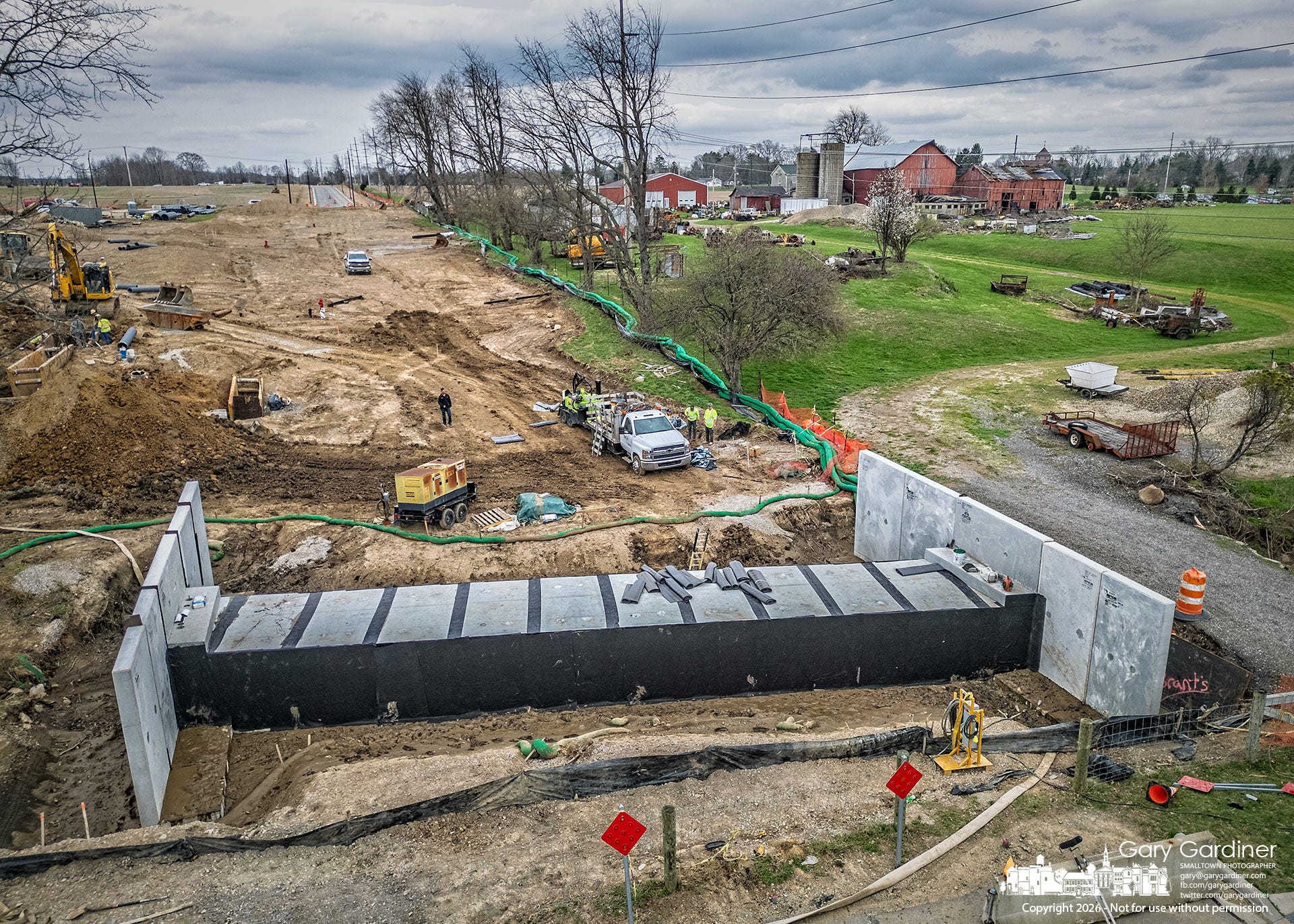
I’ve made a lot of photographs of the work on this bridge over the course of the East of Africa project, from the first tree clearing along the creek bank to the flooding and winter weather that pushed progress back for months. That sequence has value as a record of how the site changed over time. But I knew that once the culvert was set into the gnawed-out channel of Alkyre Run, the picture could become something more than documentation. At that point, the visual contrast was fully in place: this hard concrete insertion pressing against the weathered barns and open ground of the farm beside it.
Precast concrete culvert and panels were lowered into place with a crane next to a gravel-covered road, its surface compacted over the historic culvert that has supported tractors, planters, combines, and wagons for generations of farmers whose farmers’ market delighted residents with fresh produce, hay rides, and pumpkin patches. All that remains is the land, reduced to farming to maintain agricultural taxes, and the buildings now used for storage instead of sillage.
That contrast is what gives the image its emotional pull for me. The farm is not just background. It is a familiar local landmark, one of those places that helps define this part of the city in people’s minds. Seeing it side by side with the new bridge structure makes the larger change harder to treat as an abstraction. The development is no longer just a plan, a permit, or a promise of future growth. It has taken physical form, and in doing so, it has begun to remove this eighty-eight-acre property from its agricultural identity and fold it into something else.
What interested me most in making the photograph was the closeness of those two worlds. On one side is excavation, concrete, machinery, and the straight, imposed geometry of infrastructure. On the other is grass, barns, and the looser, accumulated order of an old working farm. The image works because those conditions have not yet been separated by time or distance. They are both present at once, pressed tightly together in the same frame.
The bridge itself becomes the clearest expression of that change. It is meant as a crossing, but visually it also acts as a dividing line. It marks the point where a long-familiar landscape begins to be reorganized around a different use and a different future. For me, that is where the photograph gets its force. It is not just a picture of construction. It is a picture of farmland in the process of being surrounded, redefined, and, ultimately, lost.

PhotoCamp Daily isn’t about the technical skills needed to be a good photographer or a photojournalist. There are numerous resources available, including videos, self-help books, training courses, and classes, as well as the power of social media as a learning tool.
PhotoCamp Daily focuses on learning to experience the process of creating good photos, observing subjects, and their connection to storytelling. It’s about learning to express yourself more effectively, shaping a shared understanding of your world, and embracing the new experiences you encounter.
PhotoCamp Daily is always free! But you can pledge support at any time.
