

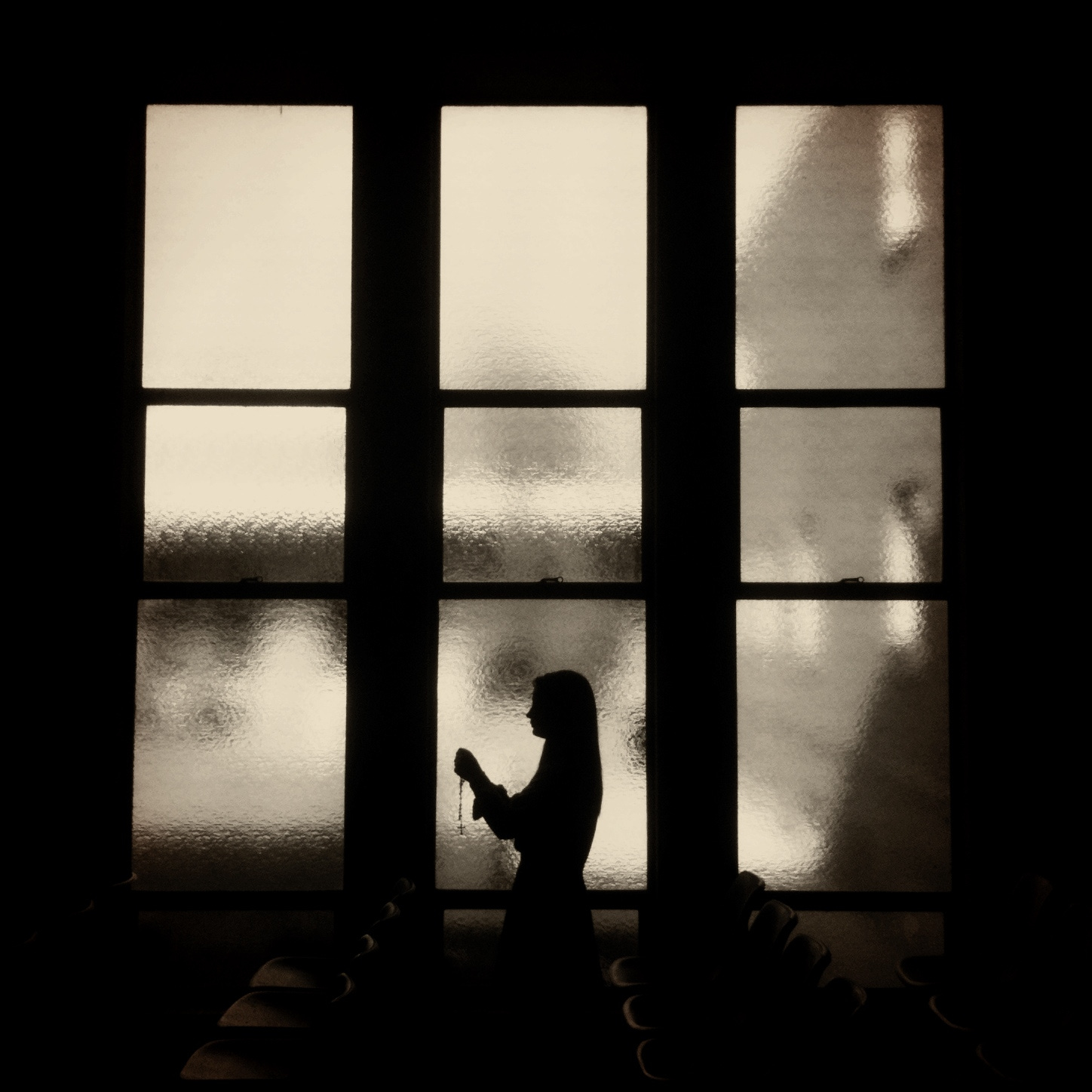
Photographers are often encouraged to show more: more detail, more expression, more context, more clarity. But some of the most compelling images are based on the opposite instinct. This photograph of a silhouetted figure in front of tall frosted windows is a powerful example of how withholding information can make an image stronger.
At first glance, the frame seems simple. A single dark figure stands in profile, hands raised, possibly holding beads or a small object, while large window panes glow softly behind her. The glass obscures everything beyond it, turning the outside world into blurred light and vague shapes. That lack of clarity is exactly what gives the photograph its emotional power. We are not told everything, so we linger longer with the image.
For photographers trying to improve, this is a valuable principle: mystery can be compositional. Not every photograph needs to explain itself immediately. In fact, some images become stronger when they leave room for interpretation. Here, the frosted glass acts almost like a veil, filtering not only light but information. The result is less documentary than poetic.
The composition is especially effective because it relies on structure. The tall window frames divide the image into vertical panels, giving the photograph order and rhythm. Against that geometry, the human silhouette becomes the emotional center. The figure is placed low and slightly off-center, which prevents the image from feeling too rigid. There is balance, but not stiffness. That is an important lesson: strong geometry works best when something human interrupts it.
Silhouette does much of the heavy lifting. The figure is simplified to just an outline, but the profile remains legible. The head, shoulders, and hands all convey meaning through their shapes alone. This serves as a great reminder that gesture can be more important than details. You don’t need facial expressions to evoke feelings if posture and outline are strong enough. In that way, the image shares similarities with the visual economy of Fan Ho, who often used shadow and shape to let atmosphere speak louder than explanation.
Tone and contrast are handled beautifully. The frame is built on a narrow palette of black, cream, and soft gray, which gives it a quiet, almost meditative mood. Because the bright window light is diffused rather than harsh, the image avoids melodrama. It feels contemplative instead of theatrical. For photographers, that is worth noticing. Mood does not always come from extremes. Sometimes it comes from subtle tonal control.
There is also a lesson here about subject reduction. The chairs at the bottom edge are barely visible, but they matter. They suggest an interior space, perhaps communal or sacred, that does not distract from the figure. The blurred forms behind the glass also add tension. They hint at life beyond the window, but remain unreadable. This creates layers without clutter, which is difficult to do well.
A gentle critique is that the darkest areas at the edges and bottom are very dense, so some viewers may feel the frame closes in a bit too much. However, that darkness is also central to the photograph’s atmosphere. It isolates the illuminated windows and gives the silhouette its strength. In this case, the heaviness feels intentional rather than accidental.
The bigger lesson for photographers is a good one: clarity isn't the only way to convey meaning. Shape, gesture, and controlled ambiguity can be just as impactful as detail. This image works because it trusts the viewer to feel first and interpret later. For anyone looking to improve in photography, that is a lesson worth holding onto. Sometimes, the most powerful frame is the one that says less but does so with conviction.

1. LUMIX ZS300 Compact Point & Shoot 4K Digital Camera, 15x Zoom Travel Camera
Panasonic’s new ZS300 is one of the clearest camera-launch stories of the day. The official product page confirms the pocketable travel-zoom design, the 20.1MP 1-inch-type sensor, and the 24–360mm equivalent 15x optical zoom, making it a notable update for photographers who still want an all-in-one compact.
2. OM System Is Surprisingly Eager to Talk About the Return of the Pen
This is one of the day’s more interesting camera-strategy stories. The report suggests OM System is seriously considering a return of the Pen line, which matters because the series still has strong appeal for photographers who want a small, stylish interchangeable-lens camera with a distinct identity.
3. Starting today, you can reorder photos and videos in your carousel posts after they’re already live
Instagram’s latest update is especially relevant for photographers and creators who rely on presentation. The new ability to reorder carousel images and videos after publishing makes it easier to refine visual storytelling, improve sequencing, and fix a post without deleting and reposting it.
4. Today we’re proud to make available six additional professional films that join the portfolio, including EKTAPAN 100, 400, and P3200
Kodak’s announcement of Ektapan 100, 400, and P3200 is one of the day’s biggest updates in film photography. It signals continued momentum in black-and-white film and reinforces that analog photography remains active enough to justify new packaging, positioning, and renewed retailer attention.
5. Flying Rodent — Josef Stefan
The Natural History Museum’s official Wildlife Photographer of the Year page highlights Josef Stefan’s lynx image, which won the 2026 Nuveen People’s Choice Award. It stands out as one of the day’s biggest public-facing photography event stories and a reminder of how much audience-driven awards still shape visibility in nature photography.
6. FBI questions Oregon photographer about protesters’ identities
This is one of the most serious photography-rights stories in the current cycle. The U.S. Press Freedom Tracker documents that independent photographer Robert Scherle was questioned by FBI agents about the identities of people he photographed at protests, raising immediate concerns about press freedom, source protection, and the risks photographers face when documenting public events.
7. Panasonic Recognizes Its Past Design May Have Been Too Practical
This story offers an unusually candid look at camera-brand thinking. Panasonic appears to be acknowledging that photographers do not choose cameras based solely on specifications, and that design character, emotional appeal, and user connection matter just as much as pure practicality.
8. Amazon Announces Its Top 10 Best-Selling Cameras, Some Will Surprise You!
Digital Camera World’s sales-chart roundup provides a timely market snapshot. It is less useful as hard industry reporting than as a quick read on what shoppers are actually buying right now, which can sometimes reveal demand trends before brands fully catch up in their messaging.
9. Nikon Reckons Its Z-Series Lenses Are So Good, It’s Chucking in a Five-Year Warranty!
This is one of the day’s more practical lens-business stories. Nikon’s five-year warranty offer signals an effort to compete on long-term ownership value and buyer confidence, not just lens sharpness or technical performance.
10. Panasonic’s Lumix ZS300 compact is disappointingly familiar
DPReview adds an independent editorial take on the ZS300 launch, arguing that the camera feels conservative despite its welcome return. Including this perspective helps round out the digest with reporting that goes beyond the official announcement and asks whether the update is enough to excite photographers.
Taken together, the last 24 hours point to a few clear themes: compact cameras remain relevant, film photography continues to hold its ground, social platforms are still shaping how photographers present their work, and the legal and professional conditions around photography are becoming just as important as the gear itself.
PhotoCamp Daily isn’t about the technical skills needed to be a good photographer or a photojournalist. There are numerous resources available, including videos, self-help books, training courses, and classes, as well as the power of social media as a learning tool.
PhotoCamp Daily focuses on learning to experience the process of creating good photos, observing subjects, and their connection to storytelling. It’s about learning to express yourself more effectively, shaping a shared understanding of your world, and embracing the new experiences you encounter.
PhotoCamp Daily is always free! But you can pledge support at any time.