

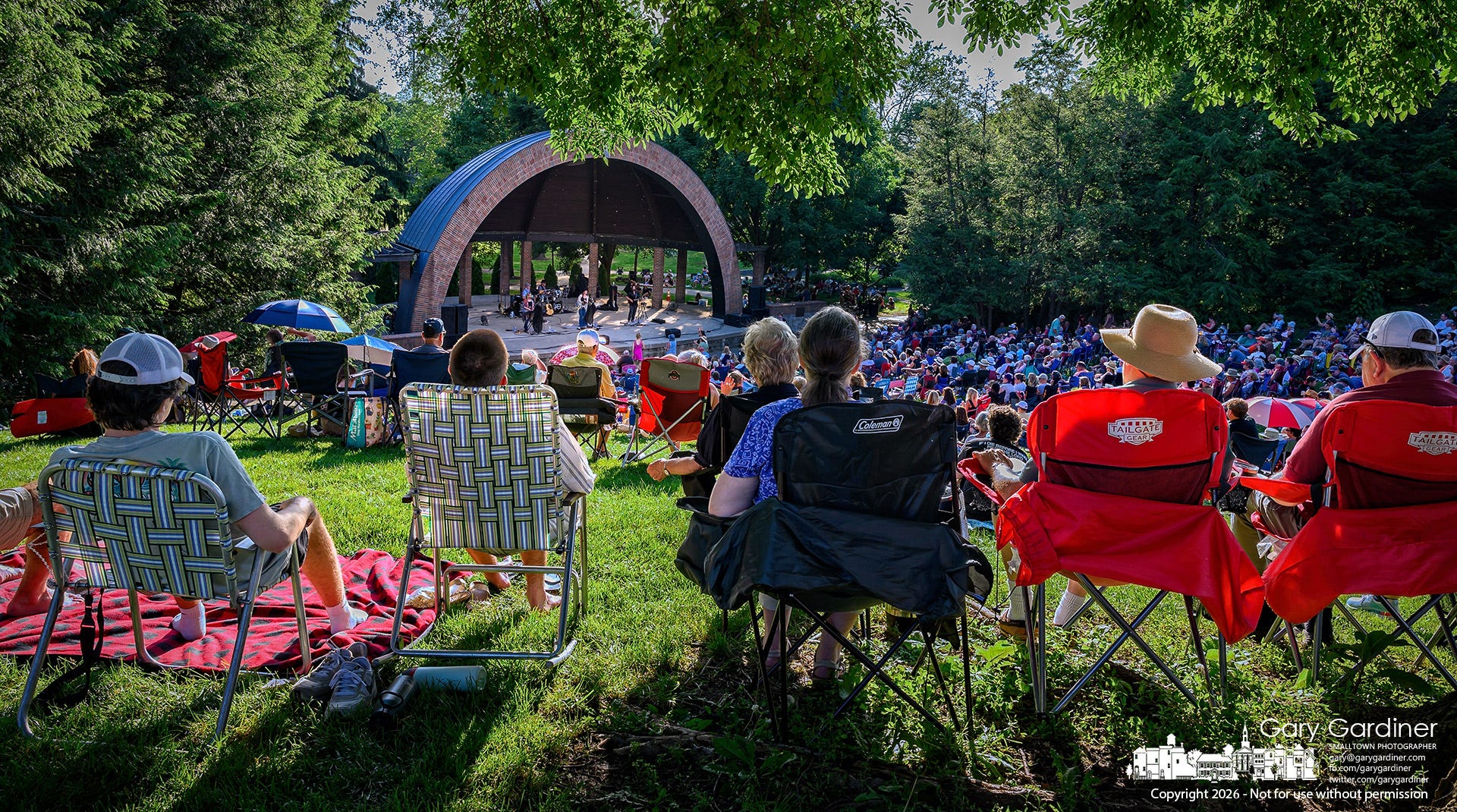
This photograph places the viewer inside the audience rather than above it. Foreground chairs, blankets, hats, and shoulders make the scene feel inhabited. The viewer is not merely observing a concert in a park but sitting behind people who arrived early, claimed a patch of grass, and settled in for the afternoon.
The bandshell gives the composition a clear destination. Its broad arch is easy to locate without dominating the frame, allowing the audience to remain part of the story. Rows of chairs and spectators guide the eye downhill toward the stage. The figures nearest the camera establish scale and suggest that the crowd continues beyond the edges of the photograph.
Color helps organize the busy scene. Bright red chairs on the right form a strong visual anchor, while patterned chairs on the left provide a looser counterweight. The surrounding grass and trees unify the frame. Small patches of sunlight catch hats, shoulders, and chair backs, separating one layer of the audience from another.
The framing beneath the trees is especially effective. Dark foliage along the top and sides contains the composition and reinforces the shaded atmosphere of the foreground. Beyond it, the stage and lower lawn open into brighter light. That transition from dark to bright creates depth and gives the eye a clear path through the image.
Photography takeaways
The image succeeds through foreground presence, repeated forms, and a clearly defined destination. Rather than stripping away detail, the photographer organizes a crowded scene through layering, color, and directional flow.
Use foreground figures and objects to place the viewer inside an event.
Give a crowded composition one clear destination.
Let repeated chairs, heads, and hats establish rhythm.
Use natural framing to contain a wide scene.
Balance strong areas of color across the frame.
Use changes in light to separate foreground, middle ground, and background.
Preserve enough context to show how people experience the setting.
The bones are good. The main repair is compression: trust the first strong observation and stop explaining it after the jury has already returned a verdict.

PhotoCamp Daily isn’t about the technical skills needed to be a good photographer or a photojournalist. There are numerous resources available, including videos, self-help books, training courses, and classes, as well as the power of social media as a learning tool.
PhotoCamp Daily focuses on learning to experience the process of creating good photos, observing subjects, and their connection to storytelling. It’s about learning to express yourself more effectively, shaping a shared understanding of your world, and embracing the new experiences you encounter.
PhotoCamp Daily is always free! But you can pledge support at any time.
