

One Face Holds the Frame
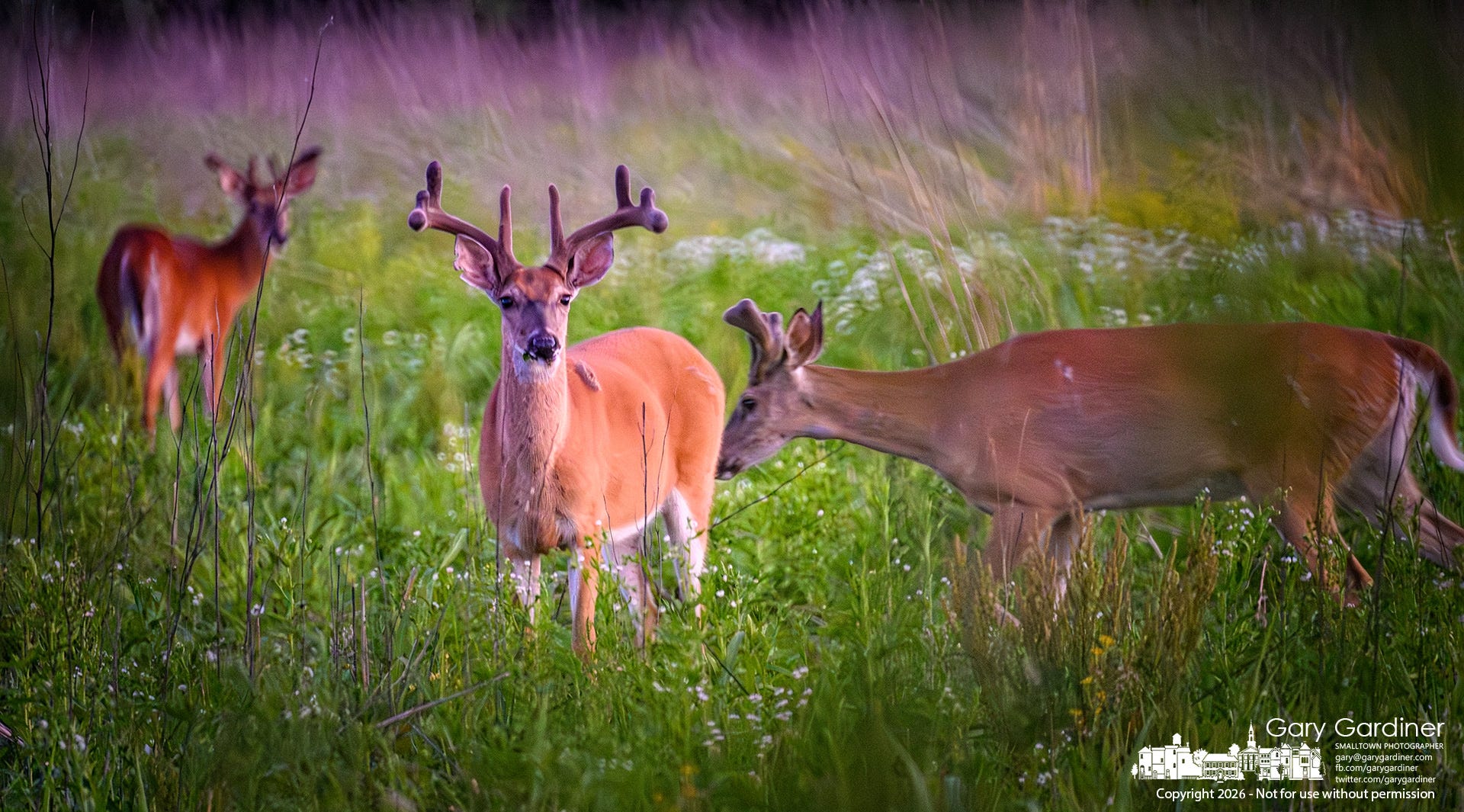
The photograph works because the three deer occupy different planes and behave differently. The buck at center anchors the frame, facing the camera with a sharp, alert gaze. At right, another deer moves into his space, while a third stands softly out of focus in the distance. That combination of stillness, motion, and depth gives the scene more life than a clean portrait of a single animal.
The strongest light falls on the central buck, drawing attention to his face and antlers. His warm coat separates from the green field, while the soft band of purple near the top adds color without competing for attention. The antlers are especially effective because their silhouette remains clear against the lighter background.
The deer at right creates tension by overlapping the main subject. Its head enters the buck’s space, suggesting a fleeting social interaction rather than three animals merely sharing a field. The background deer balances the left side of the composition and establishes a sense of distance. Its softness keeps it subordinate to the buck while still contributing to the scene.
The image was made shortly after 9 p.m. The low-light exposure—1/100 second at ISO 25,600 on a Nikon Z6 III using a hand-held 500mm f8 mirror lens helps explain both the softness in the supporting deer and the careful emphasis on the central buck. Edited RAW file in Photoshop using Camera Raw Denoise.
The photograph succeeds through layering, selective focus, and timing. The composition remains slightly untidy, which makes the moment feel observed rather than arranged. The central deer provides eye contact, the deer on the right adds movement and interaction, and the distant deer gives the frame depth. Strong color separation and restrained background detail keep the visual hierarchy intact.
Photography Takeaways
Place subjects at different distances to create depth.
Let one clearly rendered face anchor a busy wildlife scene.
Time the exposure around interaction, not merely appearance.
Keep antlers, ears, and other defining shapes against uncluttered backgrounds.
Use shallow focus to separate supporting subjects from the main subject.
Allow overlap when it creates tension or connection.
Look for warm animal tones against cooler or greener surroundings.

PhotoCamp Daily isn’t about the technical skills needed to be a good photographer or a photojournalist. There are numerous resources available, including videos, self-help books, training courses, classes, and the power of social media as a learning tool.
PhotoCamp Daily focuses on learning to experience the process of creating good photos, observing subjects, and their connection to storytelling. It’s about learning to express yourself more effectively, shaping a shared understanding of your world, and embracing the new experiences you encounter.
PhotoCamp Daily is always free! But you can pledge support at any time.
