

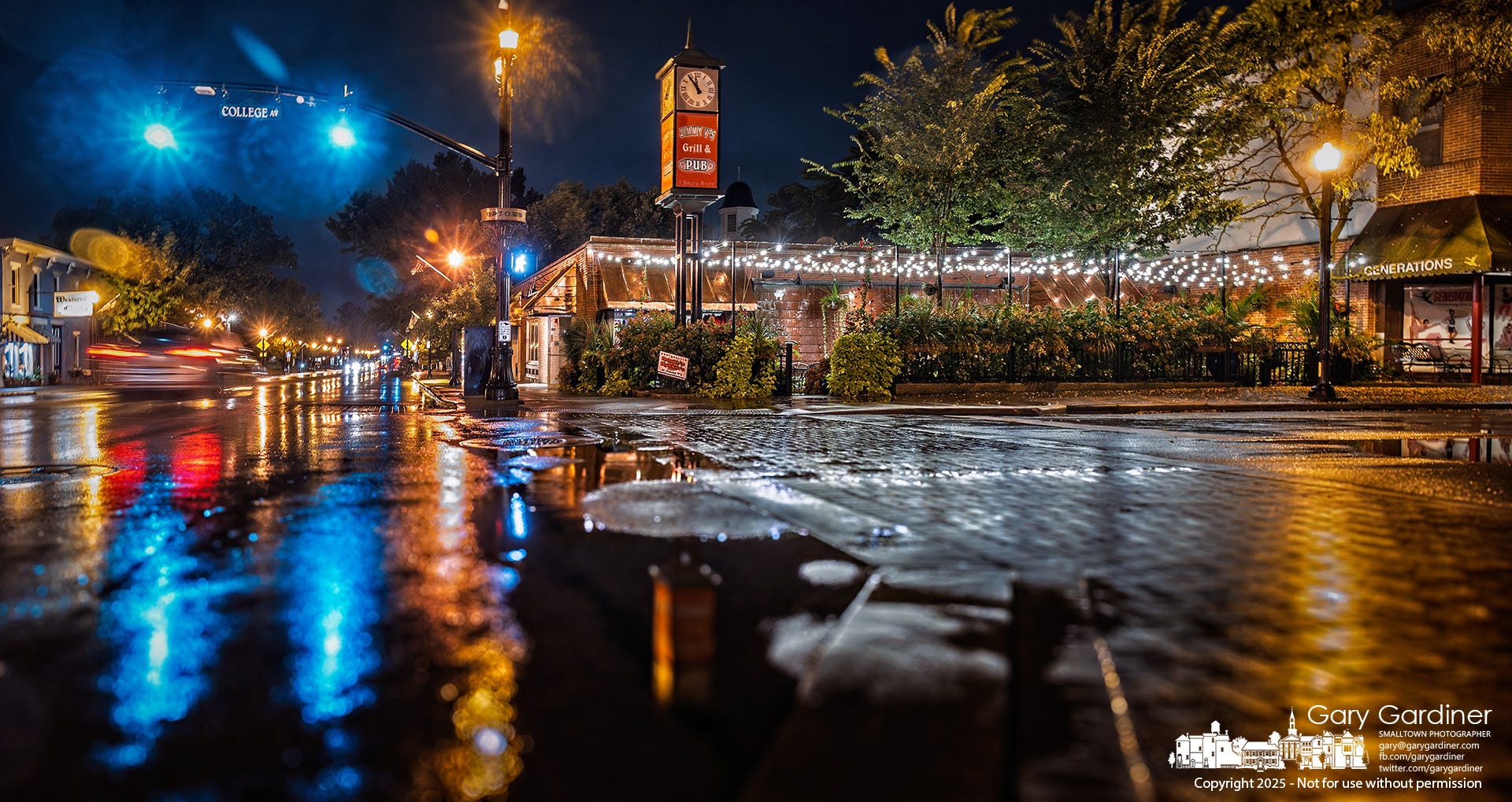
This photograph gets most of its energy from the wet pavement. The street is not just a surface here. It becomes a second field of color, stretching the blue traffic lights, red taillights, and warm storefront glow toward the camera. Without the rain, this would be a straightforward nighttime streetscape. With it, the frame gains depth, movement, and atmosphere.
The low camera position is doing important work. By placing the lens close to the street, the reflections grow larger and more dominant, while the buildings and clock remain high enough to establish the location. The puddle in the foreground acts like a visual runway, pulling the eye from the bottom edge toward the center of town.
Color is organized into two strong groups. Cool blue light holds the left side, while amber and gold dominate the right. The restaurant lights sit between them and give the middle of the frame a steady point of interest. That balance keeps the image vivid without letting one color overwhelm everything else.
The blurred car on the left adds motion at exactly the right scale. It tells us the street is active, but it does not become the subject. The clock tower provides a clean vertical anchor, and the tree canopy softens the harder lines of signs, poles, and buildings.
The metadata helps explain how the image was built. It was photographed with a Nikon Z50 II and a NIKKOR Z DX 12–28mm f/3.5–5.6 PZ VR lens at 12 mm. That wide focal length expands the street and makes the foreground reflections feel larger and more immersive. The exposure was 1/6 second at f/5 and ISO 800, using Aperture Priority, Pattern metering, and Auto white balance, with no flash. The slow shutter speed gives the moving car a soft blur while keeping the buildings, clock, and streetlights recognizable.
The sky is fully dark, the streetlights are carrying the scene, and the rain has left enough water on the pavement to hold long bands of reflected color.
Photography takeaways
This image works through reflection, viewpoint, color control, and deliberate shutter speed. The 12 mm lens turns the foreground into a major part of the composition rather than empty pavement. The 1/6-second exposure allows traffic to blur just enough to show movement while the fixed architecture remains readable. ISO 800 keeps the scene workable in low light, and f/5 provides enough depth to hold the street, clock, and buildings together.
Get low when reflections are part of the story.
Use a wide lens to make foreground elements feel larger.
Let wet pavement extend light through the frame.
Use a slow shutter speed to show motion without losing the setting.
Balance cool and warm color instead of correcting one away.
Give a wide scene one strong vertical anchor.
Keep the location readable beneath the atmosphere.

PhotoCamp Daily isn’t about the technical skills needed to be a good photographer or a photojournalist. There are numerous resources available, including videos, self-help books, training courses, classes, and the power of social media as a learning tool.
PhotoCamp Daily focuses on learning to experience the process of creating good photos, observing subjects, and their connection to storytelling. It’s about learning to express yourself more effectively, shaping a shared understanding of your world, and embracing the new experiences you encounter.
PhotoCamp Daily is always free! But you can pledge support at any time.
