

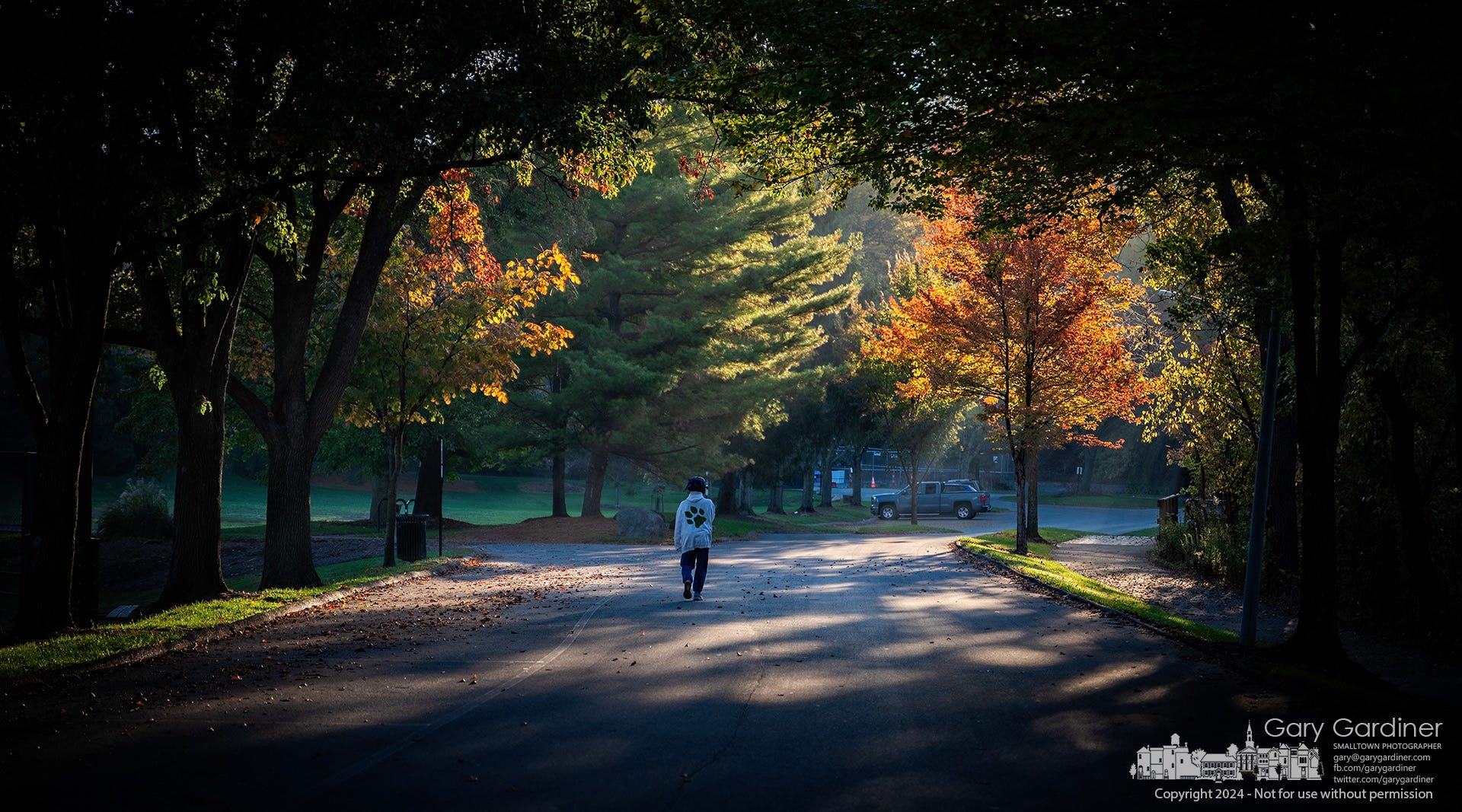
Photographers often talk about chasing dramatic subjects, but images like this remind us that a familiar road can become remarkable when light and timing come together. This photograph of a lone walker on a tree-lined street succeeds not because the subject is rare, but because the photographer captures the moment when ordinary space turns luminous.
The first lesson is light. Early or late sunlight does nearly all the emotional heavy lifting here. It slips through the trees in angled bands, catches the warm leaves, and leaves much of the frame in shadow. The contrast creates immediate depth. The road becomes a stage, the trees become curtains, and the bright middle distance invites the eye forward. For photographers trying to improve, this is a valuable reminder: light does not just reveal a scene, it organizes it.
The composition is equally strong. The road curves gently through the center of the frame, pulling the viewer inward. The overhanging trees form a natural canopy, almost like a tunnel, giving the image structure and enclosure. At the center of that space, the solitary figure provides scale and narrative. Without the person, the image would still be attractive, but it would be more about atmosphere than story. With the walker included, it becomes a scene about quiet, movement, and presence. That is a useful lesson for photographers: a small human figure can transform a scenic image into something emotionally legible.
Color is handled with restraint and intelligence. Deep greens and cool shadows dominate much of the frame, making the autumn oranges and golds feel even more precious. The figure’s white jacket also plays an important role, helping the person stand out without overwhelming the scene and giving the eye a resting point near the center of the composition. This is a good example of how contrast does not always come from brightness alone. Sometimes a photograph works because a few carefully placed warm colors emerge from a mostly dark palette.
The photograph also makes a case for patience. A scene like this can look flat or forgettable under ordinary light. The photographer waited for a moment when the sun was low enough to create long shadows and selective illumination. That patience is part of the craft. Many photographers improve not by changing equipment, but by learning that the same place can look completely different depending on the hour, the season, and the angle of light.
The image shows restraint. There is no need for exaggerated action, heavy visual clutter, or multiple subjects competing for attention. The strongest photographs often ask one clear question and answer it well. Here, the question is simple: what happens when one person moves through a road transformed by morning light? The answer is quiet, but memorable.
A gentle critique is that the parked truck and a few background details slightly interrupt the otherwise timeless mood. A different position or a tighter crop might have reduced those distractions. Still, they do not undo the photograph’s real strength, which is the way it turns an everyday roadway into a place of atmosphere and reflection.
For photographers seeking to improve, this image offers a straightforward but powerful lesson: do not underestimate familiar places. Watch how light moves through them. Look for framing created by trees, buildings, or shadows. Wait for a figure to enter the scene and give it scale. Stronger photography often begins not with traveling farther, but with seeing more deeply into the spaces you already know.

Here’s a refreshed photography news digest featuring 10 stories, events, and industry developments from the last 24 hours. This edition leans toward genuinely current items, mixing camera and lens news with exhibitions, contests, and broader photography-world developments.
1. GoPro to Unveil New Generation of Cameras at the April 2026 NAB Show
GoPro says it will debut a new generation of GP3-powered cameras at NAB 2026, with larger sensors, improved low-light performance, higher resolutions and frame rates, and a more professional focus overall. It is one of the clearest hard-news photography announcements in the current cycle because it comes directly from the company and points to a significant product shift. (GoPro)
2. LK Samyang’s latest lens is meant to be a small and light companion for Sony shooters
DPReview reports that LK Samyang’s AF 35mm F1.8 P FE has just been announced as a compact, lightweight lens for Sony E-mount. For photographers who care about portable full-frame kits, it stands out as a practical release rather than a niche specialty optic. (DPReview)
3. Tamron: “We are moving toward simultaneous multi-mount lens launches” instead of Sony-first
This DPReview interview is one of the more meaningful lens-industry stories today. Tamron says it is moving toward launching lenses for multiple mounts at the same time instead of prioritizing Sony first, which could matter a lot for photographers using Nikon Z or Canon RF systems who have been waiting for wider third-party support. (DPReview)
4. Ricoh’s film future in question as Pentax 17 lead designer moves on
DPReview says Takeo “TKO” Suzuki, the lead designer behind the Pentax 17, announced on Instagram that he is leaving Ricoh Imaging. That makes this a notable story for film-photography enthusiasts because it raises fresh uncertainty around the direction of Ricoh’s recent analog ambitions. (DPReview)
5. Kodak announced new Ektacolor Pro and Ektapan photographic film
Kodak’s latest film push remains one of the biggest analog stories in the last 24 hours. PhotoRumors reports that the company has introduced new Ektacolor Pro and Ektapan still-photography films, reinforcing the continued commercial momentum behind film photography in 2026. (Photo Rumors)
6. Update on the GoPro vs. Insta360 lawsuit
This is a timely business-and-imaging story with practical implications for the action-camera and 360-camera market. PhotoRumors says the latest result affects only certain legacy Insta360 Ace models and does not impact current cameras or U.S. sales of newer products, which helps clarify what the dispute does and does not change right now. (Photo Rumors)
7. A new DSLR camera might be on the horizon 🤩 “In short, yes, the new one is coming in 26, no speculation,” says trusted source
Digital Camera World says a new Pentax DSLR is still on the way in 2026, which is unusual enough to count as real news in a market dominated by mirrorless systems. Even as much of the industry moves elsewhere, Pentax continues to serve photographers who still want an optical-viewfinder experience. (Digital Camera World)
8. Join the Lilley Museum of Art for artist Ayana V. Jackson in conversation with Roxane Gay
The University of Nevada, Reno announced today that artist Ayana V. Jackson will appear in conversation with Roxane Gay on April 4 at the Lilley Museum of Art. It earns a place here because Jackson is a major photography-based artist, and this is exactly the kind of current event that photography audiences often want in a broader daily digest. (University of Nevada, Reno)
9. Professor emeritus Tom Stoffregen exhibits photos at Alliance Française
The University of Minnesota announced today that Tom Stoffregen’s exhibition Caen Noir et Blanc will open on April 2 at Alliance Française of Minneapolis/St. Paul. The show features black-and-white photographs from Normandy and adds a fresh exhibition item to the day’s mix of more gear-heavy stories. (School of Kinesiology)
10. Nelson discusses new exhibition and artist in residence role at SETI Institute
The University of Richmond published a new item on Brittany Nelson, an associate professor of photography and extended media, highlighting her current exhibition and her artist-in-residence role at the SETI Institute. It is a strong art-photography entry for this digest because it connects exhibition practice with institutional recognition and science-oriented creative work.
PhotoCamp Daily isn’t about the technical skills needed to be a good photographer or a photojournalist. There are numerous resources available, including videos, self-help books, training courses, and classes, as well as the power of social media as a learning tool.
PhotoCamp Daily focuses on learning to experience the process of creating good photos, observing subjects, and their connection to storytelling. It’s about learning to express yourself more effectively, shaping a shared understanding of your world, and embracing the new experiences you encounter.
PhotoCamp Daily is always free! But you can pledge support at any time.