

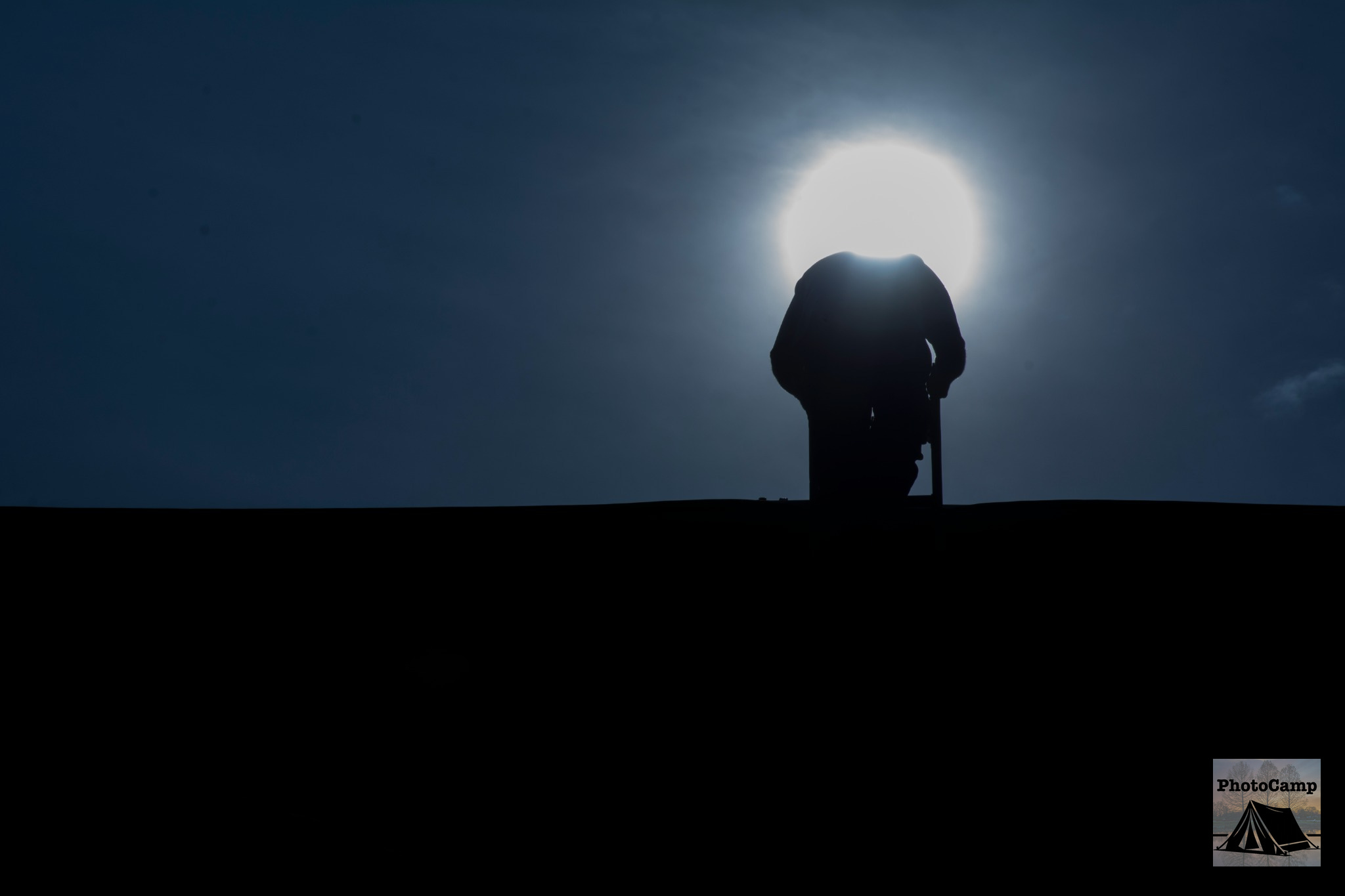
When I made this photo, I focused less on detail and more on simplicity. Photographers often aim to show everything: the face, the clothing, the setting, and every texture. In this shot, I chose the opposite. I allowed the roofer to become a dark silhouette against the bright sun because I wanted shape, not detail, to tell the story.
What made the image effective for me was the worker’s outline. He’s standing on the roofline with one knee bent, leaning slightly forward, with a tool hanging at his side. I didn’t need facial features or extra background details to understand what was happening. His posture conveyed enough. It showed a person at work, elevated, exposed, and physically engaged. That’s something I try to remember when I shoot: gesture and contour can often say more, and say it faster, than detail ever could.
I wanted the composition to feel stripped down to its essentials. There are only three elements in the frame: the dark roofline, the silhouetted figure, and the bright sun set in a wide blue sky. That simplicity gives the image its strength. Nothing distracts from the relationship between the worker and the light.
Placing the sun directly behind the worker was important to me. It creates an almost halo-like effect and makes him appear larger and more monumental. What could have been a simple work scene started to feel more symbolic, almost mythic. It became less about one roofer on a roof and more about human effort against something powerful and elemental. That’s one reason I like backlighting so much. It can turn an ordinary moment into something more intense.
The roofline plays a significant role in the composition. It runs neatly across the lower part of the image and creates a sharp division between darkness and sky. That line provides the photograph with structure, while also adding tension. The figure appears balanced right on the edge, and this sense of precariousness enhances the emotional impact.
Exposure was crucial to the decision here. I exposed for the highlights and let the roofer and roof fall almost to black. That wasn’t something I aimed to avoid; it was the goal. Keeping shadow detail would have weakened the image. For me, exposure in a scene like this isn’t just technical. It’s interpretive. What I choose to lose is part of what I choose to say.
I also appreciate how limited the color palette is. The deep blue sky and the white-hot sun set a clean stage for the silhouette. Because the colors are so simple, the eye is drawn directly to the form and placement. This kind of visual simplicity can make an image feel more powerful, not emptier.
The sun is so intense that it slightly overwhelms the upper edge of the figure, almost merging the head and light source. I believe this contributes to the image's haunting quality. Instead of damaging the frame, it adds to its iconic feel.
What this photo taught me is simple: when the light is extreme, I don't always need to fight it. Sometimes, the better choice is to fully embrace the silhouette and trust the shape to tell the story. This image works because I let contrast, outline, and placement carry the meaning. Not every photograph needs more explanation. Sometimes, one human figure, one hard edge, and one unforgettable light source are enough.

PhotoCamp Daily isn’t about the technical skills needed to be a good photographer or a photojournalist. There are numerous resources available, including videos, self-help books, training courses, and classes, as well as the power of social media as a learning tool.
PhotoCamp Daily focuses on learning to experience the process of creating good photos, observing subjects, and their connection to storytelling. It’s about learning to express yourself more effectively, shaping a shared understanding of your world, and embracing the new experiences you encounter.
PhotoCamp Daily is always free! But you can pledge support at any time.
