

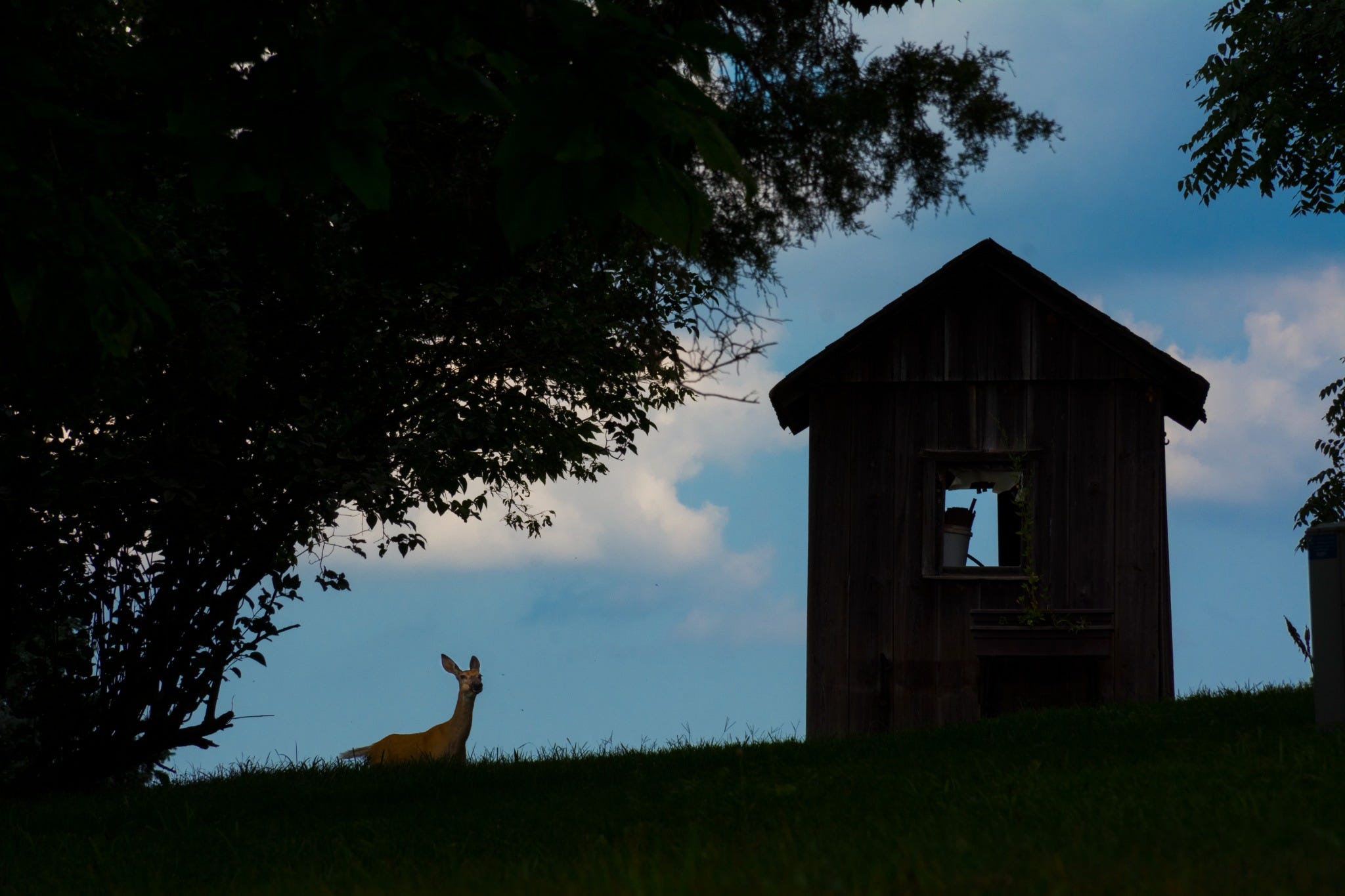
The real power of this image comes from the way its subjects lean against each other. A deer and an old shed, held in the same pale evening light, create something more resonant together than either one would alone.
The silhouette is what makes the image take hold so quickly. The trees, the shed, and the slope all fall into shadow, while the sky behind them stays pale and bright. That choice strips the frame down to what matters. We are not distracted by texture or pulled into small descriptive details. We read the image through shape, spacing, and the tension between dark and light. It is a reminder that when a scene feels too full, reduction is often what gives it force.
The deer is small, and that smallness matters. It does not feel staged or presented. It feels simply noticed. The outline of its ears, head, and neck against the lighter sky is enough to make it legible, and the fact that we do not see more only deepens the image. The deer feels discovered rather than displayed. That kind of restraint often makes wildlife photographs more affecting, because the animal remains part of the landscape rather than becoming a performance within it.
What gives the image its deeper pull, though, is the shed. The deer by itself would still be lovely. The shed by itself would still have atmosphere. But together they begin to press against each other in a way that feels quietly meaningful. The photograph holds wildness beside structure, instinct beside shelter, living presence beside something built and emptied out. It never says any of this outright, and that is exactly why it works. The image leaves room for feeling.
The negative space is part of what allows that feeling to build. The pale sky between the dense trees on the left and the shed on the right gives the picture room to breathe. Both subjects are allowed to be present. The deer does not disappear, and the shed does not dominate. The space between them starts to feel like more than background. It becomes a kind of hush, a pause that holds the image together. Even the dark branches overhead and the slope below help create that sense of enclosure. The photograph feels held, but never crowded.
There is also something to learn from what the photographer chose not to do. They did not force detail into the shadows. They did not try to make every part of the frame equally visible. They let the darkness stay dark, and the image becomes more powerful because of it. So often, photographers mistake information for depth, when it's mystery that actually gives an image its pull. Here, the sky becomes a quiet stage, and the deer and shed stand against it as spare, readable forms. Nothing extra is asked of the frame.
A minor critique is that the deer sits so low and so quietly in the composition that some viewers may miss it at first, especially given the left side's heavy visual weight. But even that feels true to the image. The photograph does not reveal itself all at once. It asks for a second look. It asks the viewer to slow down and notice. That feels right. A deer in a landscape should not arrive as an announcement.
What stays with me most is the restraint. This image does not depend on spectacle or obvious drama. It trusts shape, tension, and the strange emotional weight that can come from placing two unlike things beside each other and letting them speak without explanation. That is such an important lesson for photographers. Sometimes a photograph becomes memorable not because one subject takes over, but because two quiet forms make each other more vivid simply by sharing the dark.

1. AF 35mm F1.8 P FE
LK Samyang’s newly announced AF 35mm F1.8 P FE is one of the clearest same-day lens stories in photography right now. The company positions it as a compact, lightweight Sony E-mount prime for hybrid creators and everyday photographers, making it a practical release rather than a niche specialty lens. (DJI Official)
2. The National Geographic Museum of Exploration Will Open on June 26, 2026
National Geographic announced on March 26 that its new Museum of Exploration will open on June 26 in Washington, D.C. For photography audiences, the most notable angle is that the museum will feature major photographic work, including Joel Sartore’s Photo Ark, alongside other visual storytelling from the Society’s archive. (National Geographic Newsroom)
3. Pictures of the Day | March 27, 2026
Reuters’ daily pictures package is one of the strongest current windows into professional photojournalism. Today’s gallery leads with images from Tehran and other major world events, making it useful not just as a news roundup but as a snapshot of what top wire photographers are prioritizing visually right now. (Reuters)
4. Taylor Swift, a cloned sheep and China fashion week: photos of the day – Friday
The Guardian’s picture editors published a fresh global photo selection today, spanning conflict, fashion, celebrity, and daily life. It adds a different editorial voice from Reuters or AP and helps broaden the digest beyond gear and product news into the images dominating the day’s visual culture. (The Guardian)
5. A world in bloom: Spring flowers unfold from Tokyo to Mexico, in photos
AP’s spring photo gallery was published today and offers a more thematic, feature-style take on current photography. Instead of hard news, it focuses on seasonal imagery from multiple countries, which makes it a strong example of how major newsrooms still use photography to tell quieter, more atmospheric stories. (AP News)
6. A vigil in Colombia, Messi in action and other top photos from Latin America and the Caribbean
Also published today, this AP gallery narrows the focus to Latin America and the Caribbean. It is worth including because it gives the digest stronger geographic range and shows how regional photo editing can surface stories and images that would be easy to miss in broader global roundups. (AP News)
7. The week’s best photos
The Week published its latest photo roundup on March 27, adding another distinct editorial curation layer to the mix. It is less about breaking photography industry news and more about which images are resonating across the news cycle, which still makes it useful in a last-24-hours visual digest. (The Week)
8. PhotoCarmel 2026: A Celebration of Photography on the Central Coast
PhotoCarmel kicks off today, March 27, as a six-week celebration of photography on California’s Central Coast. I included it because it is a live photography event happening now, not just an article, and it broadens the digest beyond media coverage into actual programming for photographers and photo audiences. (Center for Photographic Art)
9. Keynote Speakers PhotoCarmel: Kelli Connell and Dr. Rebecca Senf, artist talk and book signing
Another live item from today’s PhotoCarmel launch, this keynote event adds a direct artist-talk component to the digest. It stands out because it centers contemporary photographic practice and publishing, rather than only awards, gear, or photojournalism. (Center for Photographic Art)
10. Introduction to the Exhibition: Photography and the Black Arts Movement, 1955–1985
The National Gallery of Art has an opening-day program today tied to its exhibition Photography and the Black Arts Movement, 1955–1985. This earns a place because it is a major museum event happening today and brings historical and cultural depth to a digest that otherwise might skew too heavily toward current photo galleries and gear coverage. (National Gallery of Art)
Taken together, the last 24 hours in photography look broader than just camera news: there is a new lens launch, major editorial image roundups from global newsrooms, a museum announcement with real photographic significance, and live photography events opening today in both institutional and community settings.
PhotoCamp Daily isn’t about the technical skills needed to be a good photographer or a photojournalist. There are numerous resources available, including videos, self-help books, training courses, and classes, as well as the power of social media as a learning tool.
PhotoCamp Daily focuses on learning to experience the process of creating good photos, observing subjects, and their connection to storytelling. It’s about learning to express yourself more effectively, shaping a shared understanding of your world, and embracing the new experiences you encounter.
PhotoCamp Daily is always free! But you can pledge support at any time.