

Story Without Detail
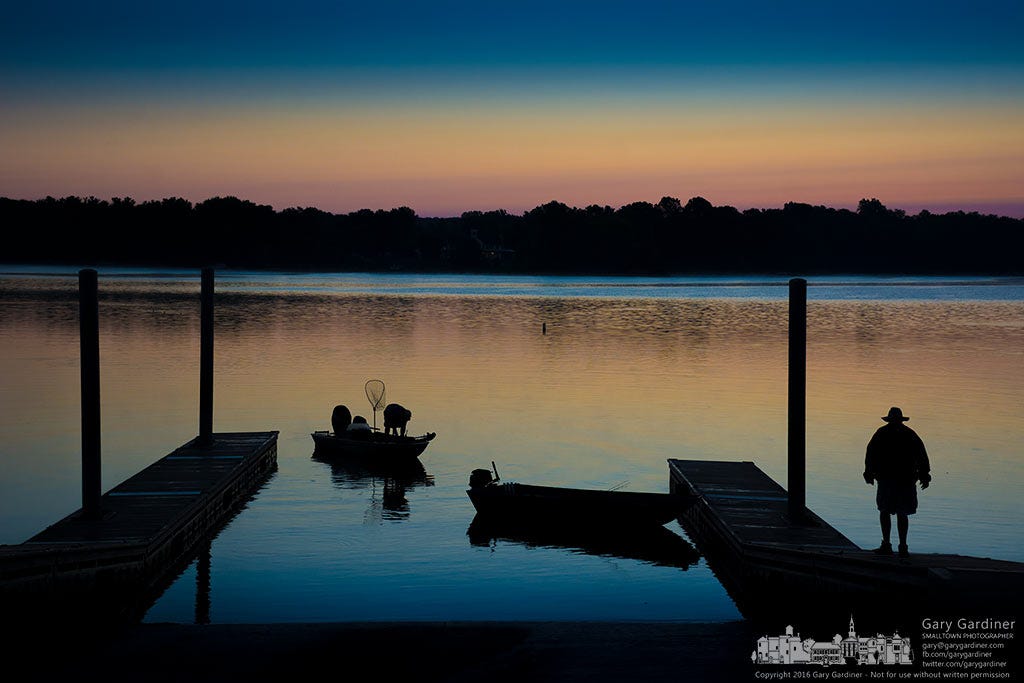
Before sunrise at Hoover Reservoir, there isn’t enough light to describe the people in the conventional sense. That absence of detail becomes one of the photograph’s strengths. We don’t need to see anything about the specific subjects to understand what is happening.
The silhouettes provide nearly everything necessary. A person stands at the end of the dock on the right. A small fishing boat sits farther out, its occupants reduced to shapes. The landing net rising from the boat supplies an especially useful clue. Without revealing much, the photograph establishes fishing, water, people, and the beginning of a day.
The composition depends on balancing asymmetrical elements. The two docks enter from opposite sides and lead toward the open water, creating a broad visual structure across the bottom of the frame. The standing figure gives substantial weight to the right side. The smaller but more complex silhouette of the fishing boat and its occupants counters it on the left. A tighter crop that removes the subject on the right would flatten the photo and reduce its depth.
The empty water between them matters. Filling that space with another boat or person would weaken the separation of the two principal elements. Instead, each has room to exist independently while remaining part of the same scene.
There are also several strong verticals. The dock posts rise through the horizontal layers of water, distant shoreline, and sky. The figure on the right becomes another vertical, while the net provides a smaller one within the boat. Those shapes keep the photograph from becoming a succession of horizontal bands.
Before sunrise, the sky and its reflection provide most of the color. The dark shoreline divides them, while the silhouettes anchor the softer gradations of blue, gold and pink. Exposing for that light allows the foreground figures to fall naturally into darkness.
That darkness removes individual identity but preserves human activity. We know enough from posture, shape and context to construct the scene ourselves.
The photograph therefore depends on an apparent contradiction: by showing less about the people, the silhouettes make the activity easier to see.

PhotoCamp Daily isn’t about the technical skills needed to be a good photographer or a photojournalist. Numerous resources are available, including videos, self-help books, training courses, classes, and social media as a learning tool.
PhotoCamp Daily focuses on learning the process of creating good photos, observing subjects, and connecting them to storytelling. It’s about learning to express yourself more effectively, shaping a shared understanding of your world, and embracing new experiences.
PhotoCamp Daily is always free! But you can pledge support at any time.
