

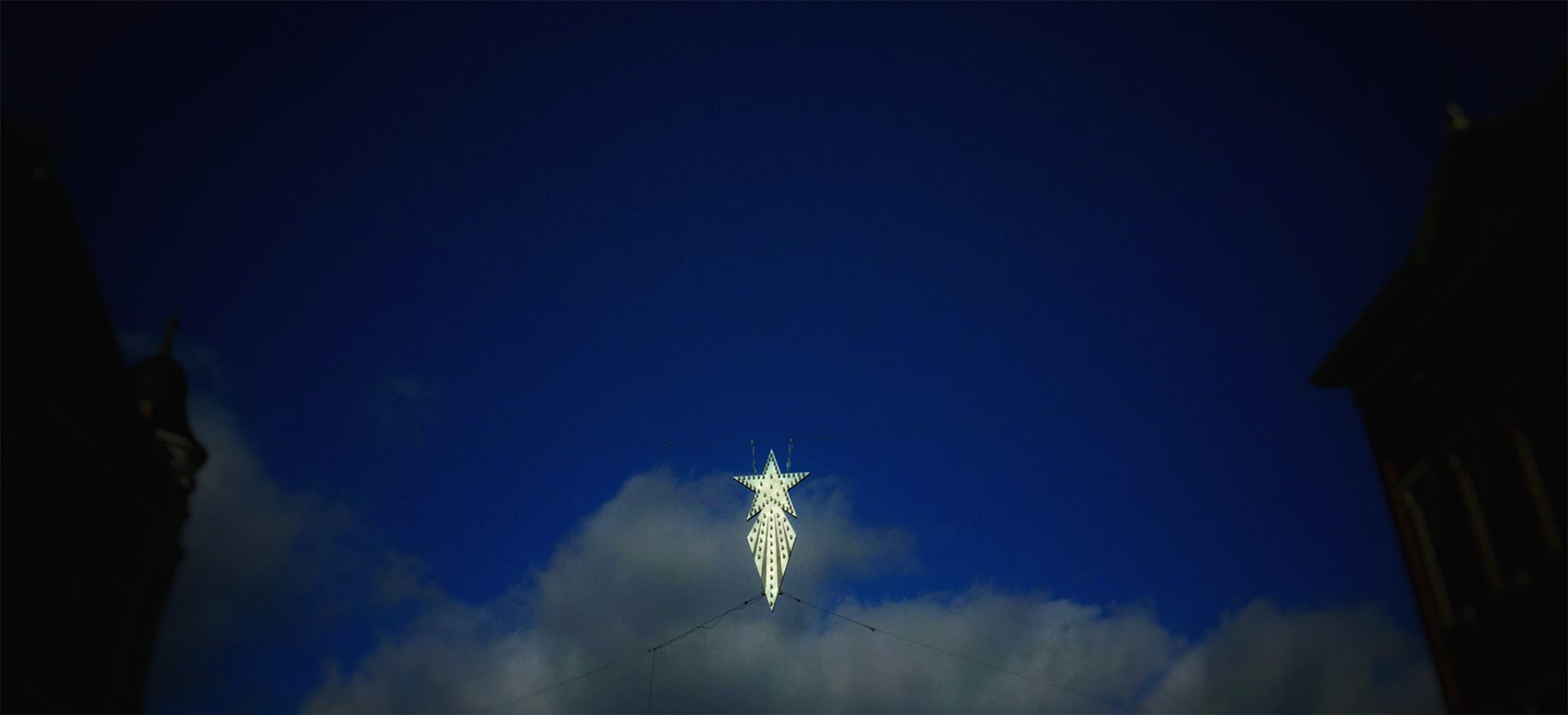
When you photograph a single subject—like a bright artificial star hanging over a street—the first decision is what the picture is not about. This image works because the photographer reduces the scene to one clear idea. The street is secondary. The buildings are secondary. Everything exists to support the star.
The camera angles upward, removing most street-level distractions. Cars, people, signage, and storefronts are excluded, leaving the sky to carry most of the frame. This choice simplifies the scene immediately and turns a common decoration into something isolated and contemplative.
Composition relies heavily on space. The star sits low in the frame, with a wide expanse of sky above it. That empty space is intentional. It creates calm and makes the subject feel suspended rather than crowded. Placing the star higher would reduce the sense of openness. Centering it vertically would flatten the image.
The dark buildings on either side play a quiet but important role. They act as visual brackets, keeping the viewer’s gaze from drifting outward. Underexposed, they register as shapes rather than structures—framing elements instead of competing subjects. Their presence suggests a street setting, while their darkness keeps attention on the star.
A faint layer of clouds adds depth to the sky. Subtle but effective, they provide dimension and prevent the background from feeling flat. They also help place the star closer to the viewer, suspended in the space of the street rather than floating in an abstract field of color. This slight texture gives the image scale without distracting from the subject.
Timing is critical. The photograph is made in early evening, when the sky still holds color but daylight is fading. This short window allows the blue to remain rich and layered while the artificial star is already glowing. Too early, and the light feels ordinary. Too late, and the sky collapses into black.
Exposure is handled with discipline. The photographer meters for the brightest part of the star, preserving its shape and internal detail. Everything else falls into shadow. The buildings darken. The wires remain faint. This approach simplifies the frame and reinforces the subject. Recovering shadow detail would only weaken the image.
Color is treated with restraint. The sky remains blue rather than neutralized. The star stays clean and white. There’s no aggressive contrast or saturation. The natural separation between subject and background is enough.
Editing appears minimal and controlled. The sky looks smooth without appearing artificial. Shadows are not lifted for the sake of information. Nothing is sharpened to distraction. The image feels quiet because the photographer knows when to stop.
Photographs like this depend on patience and reduction. Find a subject that can stand alone. Move until the surrounding elements disappear or serve as framing. Wait for light that supports the mood. Expose for what matters and let the rest fall away. When a small object is given space, structure, and the right light, it can carry an entire photograph on its own.

PhotoCamp Daily isn’t about the technical skills needed to be a good photographer or a photojournalist. There are numerous resources available, including videos, self-help books, training courses, and classes, as well as the power of social media as a learning tool.
PhotoCamp Daily focuses on learning to experience creating good photos, observing subjects, and their connection to storytelling. It’s about learning to express yourself more effectively, shaping a shared understanding of your world, and embracing the new experiences you encounter.
PhotoCamp Daily is always free! But you can pledge support at any time.
Consider subscribing to The Westerville News and My Final Photo News. Also recommended is Into the Morning by Krista Steele.
My Final Photo News is a reader-supported publication. To receive new posts and support photography and commentary, consider becoming a free or paid subscriber.