

Depth From Compression
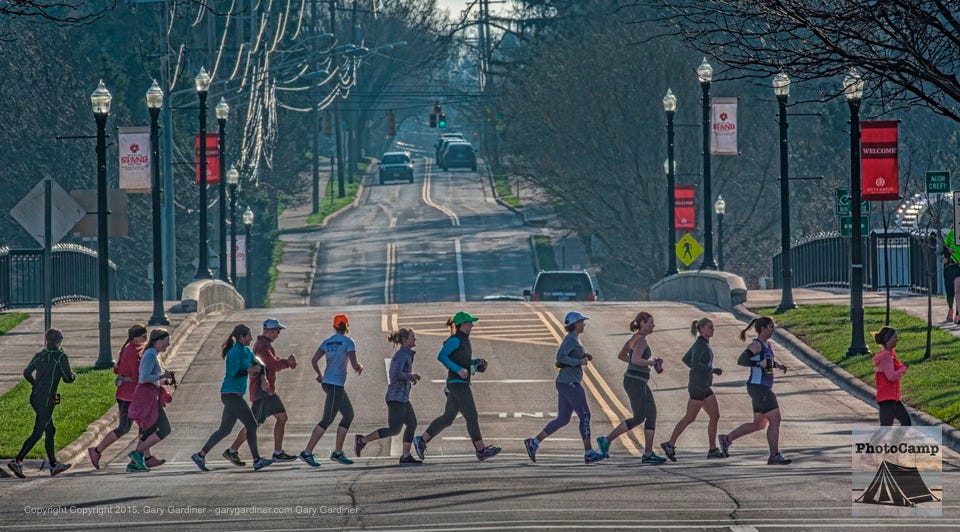
This photograph depends on a long lens doing something that at first seems contradictory. Telephoto compression visually pulls the distant parts of the scene together, yet the repeated lines, changing light, and scale create a strong impression of three-dimensional depth.
The runners provide the immediate subject. They occupy almost entirely the bottom third of the frame, crossing a relatively bright section of roadway. Their bodies form a nearly continuous sequence from left to right. Luck helped considerably. At this instant they are unusually well spaced, with very little overlap. Each runner remains an individual figure while collectively becoming a single graphic element.
The light provides another separation. The foreground has a warmer quality, particularly in the pavement, skin, and clothing. Farther into the photograph, the scene becomes progressively cooler and more blue. Atmospheric distance reinforces that shift. The result is a foreground that feels physically distinct from the background even though the long lens has compressed the apparent distance between them.
Main Street supplies the depth.
The double yellow lines begin behind the runners and repeatedly disappear and reappear as the road rises and falls. Curbs, sidewalks, utility lines and rows of streetlights all recede toward the center. Each becomes progressively smaller. The rolling roadway is particularly important because we don’t simply see a road narrowing toward a vanishing point. We see successive sections, almost like overlapping planes.
The long lens compresses those planes enough to make the repetition obvious. Cars, traffic signals, streetlights, and utility poles appear stacked along the street. Instead of becoming clutter, much of that repetition describes distance.
Camera position is equally important. The photograph is made almost directly along the axis of the street. A position substantially to either side would weaken the convergence and change the relationship among the objects.
This photograph contains an interesting second photograph. A severe crop retaining principally the bottom third could still work. The runners themselves have enough spacing, color, and gesture to sustain a composition.
But something would be lost.
Without the deep background, they could be runners crossing almost any street. The full frame tells us that this particular street matters.
The background doesn’t compete with the runners. It explains where they are.
That is one useful characteristic of deep depth of field in documentary photography. Background detail need not merely be tolerated because everything happens to be sharp. Here, sharpness allows the distant information to participate in the storytelling.
The runners provide the moment. The street provides the place. The long lens pulls the two together.

PhotoCamp Daily isn’t about the technical skills needed to be a good photographer or a photojournalist. Numerous resources are available, including videos, self-help books, training courses, classes, and social media as a learning tool.
PhotoCamp Daily focuses on learning the process of creating good photos, observing subjects, and connecting them to storytelling. It’s about learning to express yourself more effectively, shaping a shared understanding of your world, and embracing new experiences.
PhotoCamp Daily is always free! But you can pledge support at any time.
