

Wide angle: Building the frame, waiting for the moment
I had been photographing the operation for several days as lime was removed from the water plant’s holding ponds and delivered to nearby farm fields. By the time I made this photograph, I understood the process. What I didn’t yet have was this view.
The day before, I stopped at this location and took photographs with a normal lens. I also used my phone to test another possibility, shooting from beneath the tanker. The test almost worked. More importantly, it showed that the idea could work.
I returned the next day knowing where I wanted the camera.
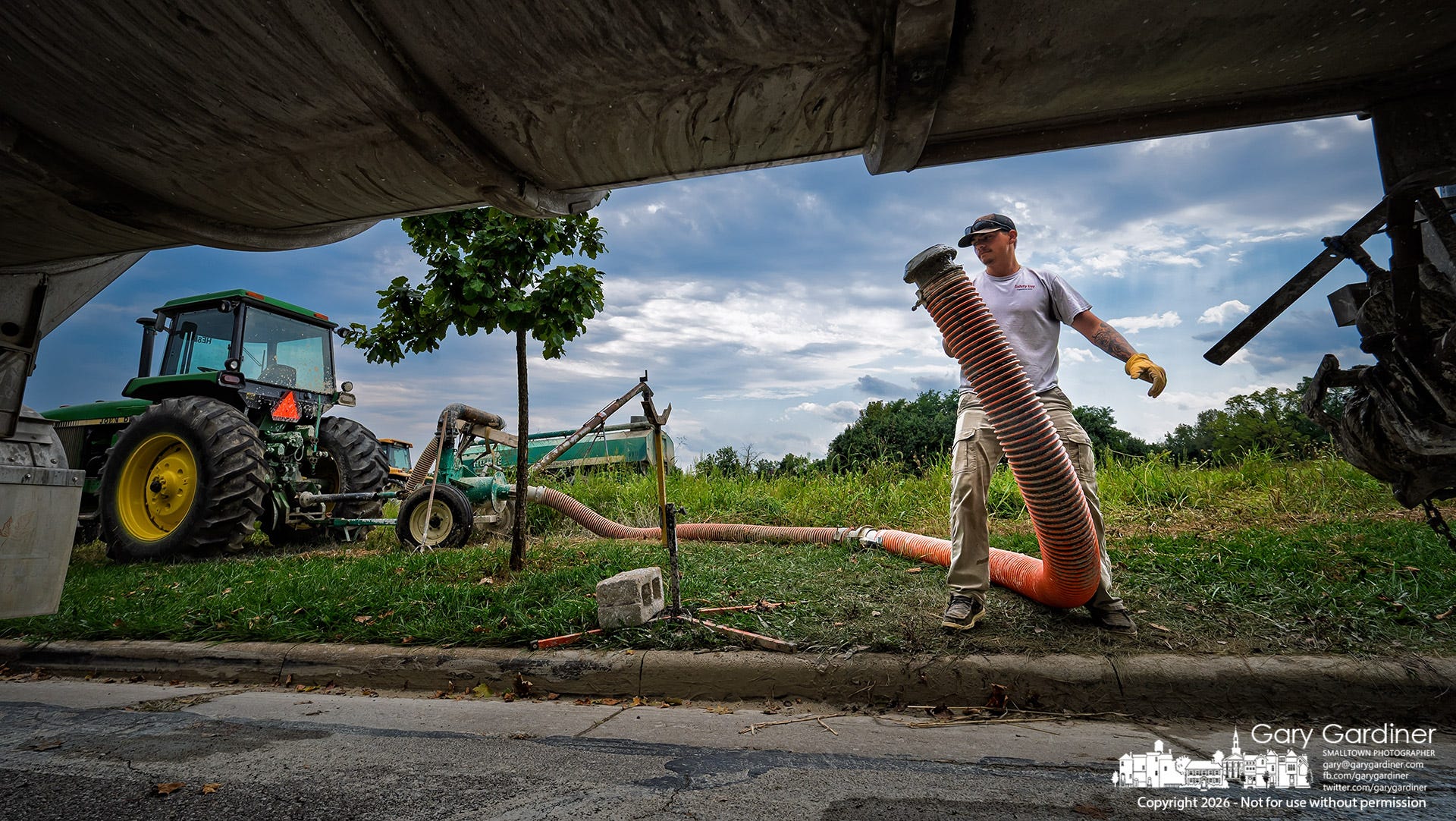
The tanker would become the frame. Its dark underside across the top and portions of its structure along the sides would surround a considerably brighter scene. But the tanker wasn’t simply convenient framing. It was part of the story. The photograph would be made from beneath the vehicle delivering the material, looking toward the equipment transferring it for use in the field.
The roadway completes the bottom of that frame. Between those foreground elements is the working area, with the tractor and pumping equipment on the left, open sky across the background, and the operator moving between them.
Three tankers gave me three opportunities. The first was largely observation. Watching it unload revealed the pattern of the operator’s movements, where he went, how he handled the hose, and where those actions might place him within the composition I had already chosen.
The second tanker provided a first attempt based on those observations. It didn’t work as planned, as the tanker was too far back, changing the pattern.
The third worked.
At that moment, the hose creates the motion through the frame. It begins with the equipment on the left, runs across the ground, and then rises in a sweeping curve as the operator carries it. His stance and outstretched arms continue the sense of movement. The orange hose separates strongly from the grass and gives the eye a path through what otherwise could have been a complicated collection of machinery.
The wide-angle lens makes all of those relationships possible. The tanker is extremely close to the camera and therefore becomes visually imposing. Beyond it, the equipment shrinks progressively, while the sky provides an uncluttered background around the worker. Foreground and background establish both depth and purpose.
The photograph resulted from two different kinds of timing. One occurred over two days, recognizing a possible camera position, testing it, returning and studying the repeated operation. The other lasted only an instant, when the operator, hose and body position came together inside a composition that was already waiting for him.
The frame was planned. The moment wasn’t.

PhotoCamp Daily isn’t about the technical skills needed to be a good photographer or a photojournalist. Numerous resources are available, including videos, self-help books, training courses, classes, and social media as a learning tool.
PhotoCamp Daily focuses on learning the process of creating good photos, observing subjects, and connecting them to storytelling. It’s about learning to express yourself more effectively, shaping a shared understanding of your world, and embracing new experiences.
PhotoCamp Daily is always free! But you can pledge support at any time.
