

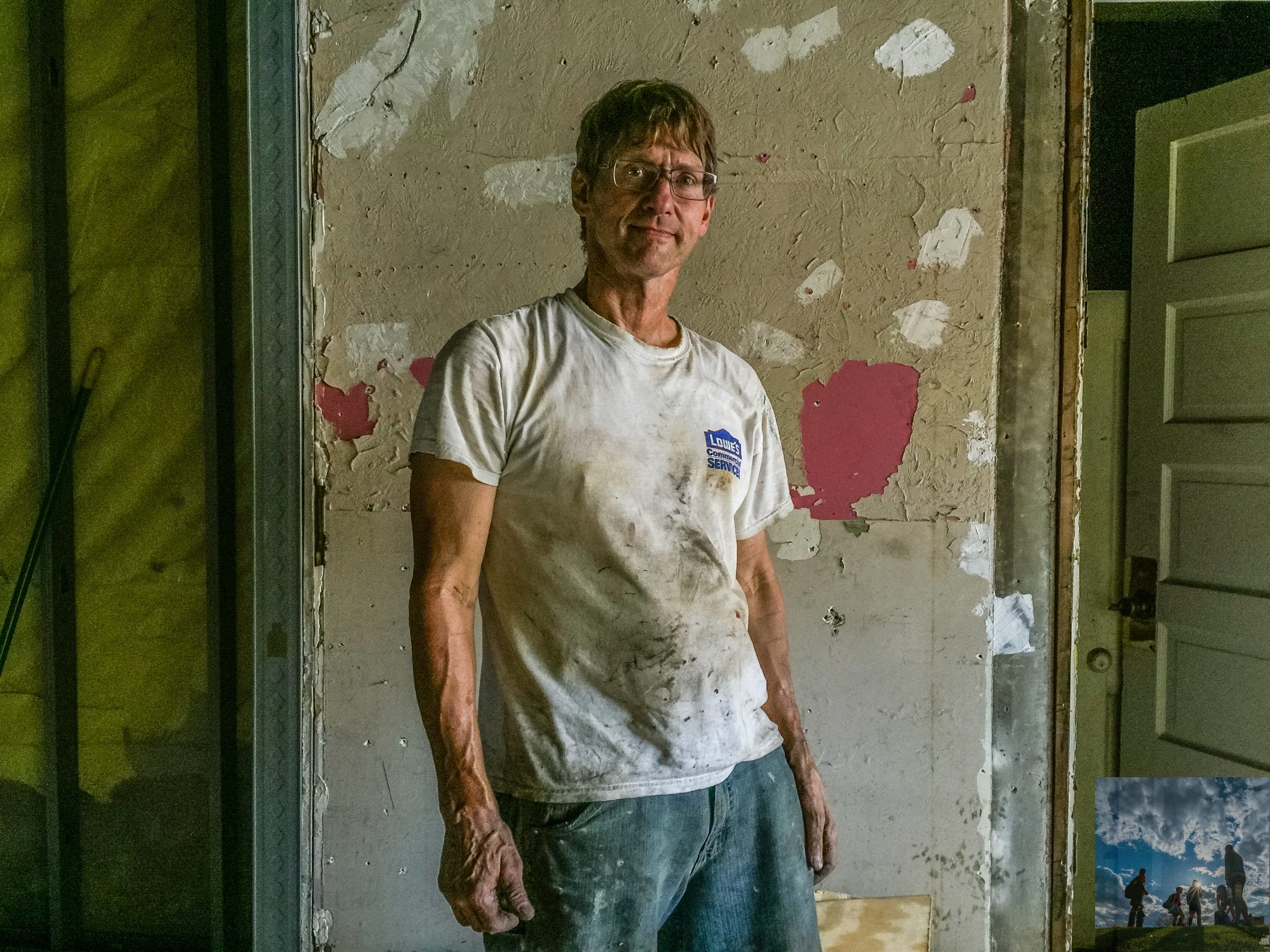
Photographers often try to clean up a portrait too much. We look for flattering light, smooth backgrounds, neat clothing, and polished surroundings. This image moves in the opposite direction, and that is exactly why it works. A worker stands in a rough interior space, his shirt marked by work, the walls scarred by demolition, a doorway open at the edge of the frame. The portrait succeeds because it does not hide the labor. It lets it remain visible.
Its first strength is honesty. The subject stands simply, looking at the camera without a theatrical pose or exaggerated expression. There is a quiet directness in that look. He seems neither to perform nor pretend. For photographers trying to improve, that is an important lesson: a portrait does not need drama to feel strong. Sometimes plain presence is more convincing than any pose you could invent.
The setting does as much storytelling as the face. The chipped wall, patched paint, exposed framing, dusty clothing, and partially open door tell us this is a place in transition. This is not just a man in a room. It is a man surrounded by the evidence of his labor. That is what makes the picture more than a casual snapshot. Good environmental portraiture works when the setting is not mere background decoration, but part of the subject’s identity.
Texture matters here. The wall is scarred and uneven. The shirt is wrinkled and stained. The arms and hands look worked. Even the dim light seems to settle into the roughness of the room. This is worth noticing: texture often helps carry truth. When a subject is tied to physical labor, too much smoothness can weaken the image. Letting rough surfaces remain visible makes the portrait feel earned.
The lighting is also instructive. It is not glamorous. It is soft, uneven, and available light, which suits the subject. The face is clear, the shirt catches enough brightness to pull the figure forward, and the darker edges of the room keep the mood grounded. Many photographers improve once they stop asking whether light is beautiful and start asking whether it is appropriate. Here, the light feels honest to the place.
Compositionally, the figure is centered enough to feel stable, but not so perfectly centered that the image turns stiff. The doorframe and wall edges create a vertical structure around him, while the damaged wall provides a textured backdrop that keeps the portrait from feeling empty. The open door on the right is especially useful. It adds depth and suggests that the room extends beyond the frame, helping the image breathe.
There is also a lesson here about imperfection. The room is messy. The wall is marked. The shirt is dirty. The framing is not fussy. Yet those very qualities are the portrait’s strength. Too many photographers strip away the clues that make a person believable. This image keeps them. It understands that dignity does not depend on polish.
A gentle critique is that the background is busy enough to slightly compete with the subject’s face, and the lighting on his face could separate him from the wall a bit more. Even so, that roughness feels true to the scene. This is not a studio portrait pretending to be real. It is a real portrait that benefits from its rough edges.
The larger takeaway is simple: when photographing people defined by work, let the signs of that work remain visible. Do not rush to tidy the frame into generic portraiture. This image succeeds because it trusts texture, posture, and place to tell the story. A portrait becomes more powerful when it reveals not just what someone looks like, but also what their day has been like.

1. DJI Avata 360 Sets New Standards for Immersive 360 FPV Flying
DJI’s official launch of the Avata 360 is one of the biggest imaging stories of the day. The company says the new drone combines 360 capture with FPV flying and positions it as a higher-end immersive camera tool, which makes it relevant not just to drone hobbyists but also to photographers and creators working in panoramic and action formats. (DJI Official)
2. AF 35mm F1.8 P FE
LK Samyang’s newly announced AF 35mm F1.8 P FE gives Sony shooters a compact new everyday prime, and the company describes it as a lighter, more portable alternative to the faster 35mm F1.4 model. For photographers building small full-frame kits, this is one of the clearest same-day lens announcements in the current cycle. (LK SAMYANG)
3. The National Geographic Museum of Exploration Will Open on June 26, 2026
National Geographic announced today that its new Museum of Exploration will open on June 26 in Washington, D.C. For photography audiences, the most notable detail is that the museum will include “Photo Ark: Animals of Earth,” featuring Joel Sartore’s wildlife portraits, alongside a broader photographic exhibition drawn from National Geographic’s image archive. (National Geographic Newsroom)
4. The top photos of the day by AP’s photojournalists
The Associated Press published its daily photo selection today, offering one of the strongest snapshots of current visual journalism anywhere. It is a useful inclusion because it reflects what major editors see as the day’s most powerful news images, not just camera or industry announcements. (AP News)
5. The top photos of the week by AP photojournalists
AP also published its weekly top-photos gallery today, broadening the digest beyond product news and into editorial photography itself. These curated image roundups matter because they show the range of subjects, styles, and moments dominating photojournalism right now. (AP News)
6. Wildlife Photographer of the Year announces winner of prestigious photography award
The Natural History Museum announced the winner of the 2026 Nuveen People’s Choice Award, with Josef Stefan taking the top honor for his image “Flying Rodent.” With a record 85,917 votes, it is one of the most visible wildlife-photography competition results in the last day. (Natural History Museum)
7. Biltmore Debuts Luminere, a New Evening Sensory Experience of Light, Imagery, and Sound
Biltmore announced a new large-scale nighttime experience built around projected imagery, light, and sound. It is more photography-adjacent than photography-pure, but it still belongs in a broad visual-culture digest because image-based experiences like this increasingly overlap with photographic exhibition and display practice. (PR Newswire)
8. ‘Footwork: Where We Gather’ Photo exhibit celebrates Atlanta’s team spirit
Emory University published a new piece today on Sheila Pree Bright’s exhibition Footwork: Where We Gather. It adds a strong art-photography entry to the roundup, centering a documentary-style body of work about community, place, and Atlanta identity rather than gear or industry chatter. (Emory News)
9. Renowned Celebrity Portrait Photographer Paul Mobley to Receive Honorary Doctorate
The College for Creative Studies announced today that portrait photographer Paul Mobley will be honored and appear in conversation on March 26. It is a timely photography event item that adds an education-and-artist-recognition angle to the list. (College for Creative Studies)
10. Roots to Rise Photography Competition Exhibition
Wichita State’s calendar lists the Roots to Rise Photography Competition Exhibition as running today at the Ulrich Museum, giving the digest a live exhibition item rather than only published articles. It is a useful reminder that “what’s new in photography” in a 24-hour window also includes active public-facing photo events, not just web stories. (Wichita State University)
There is a major drone-camera launch, a fresh lens announcement, museum and gallery news, competition results, working photojournalism, and same-day academic and cultural events.
PhotoCamp Daily isn’t about the technical skills needed to be a good photographer or a photojournalist. There are numerous resources available, including videos, self-help books, training courses, and classes, as well as the power of social media as a learning tool.
PhotoCamp Daily focuses on learning to experience the process of creating good photos, observing subjects, and their connection to storytelling. It’s about learning to express yourself more effectively, shaping a shared understanding of your world, and embracing the new experiences you encounter.
PhotoCamp Daily is always free! But you can pledge support at any time.