

Work Has Weight
The strongest work photographs do more than show a job being done; they let the viewer feel the effort.
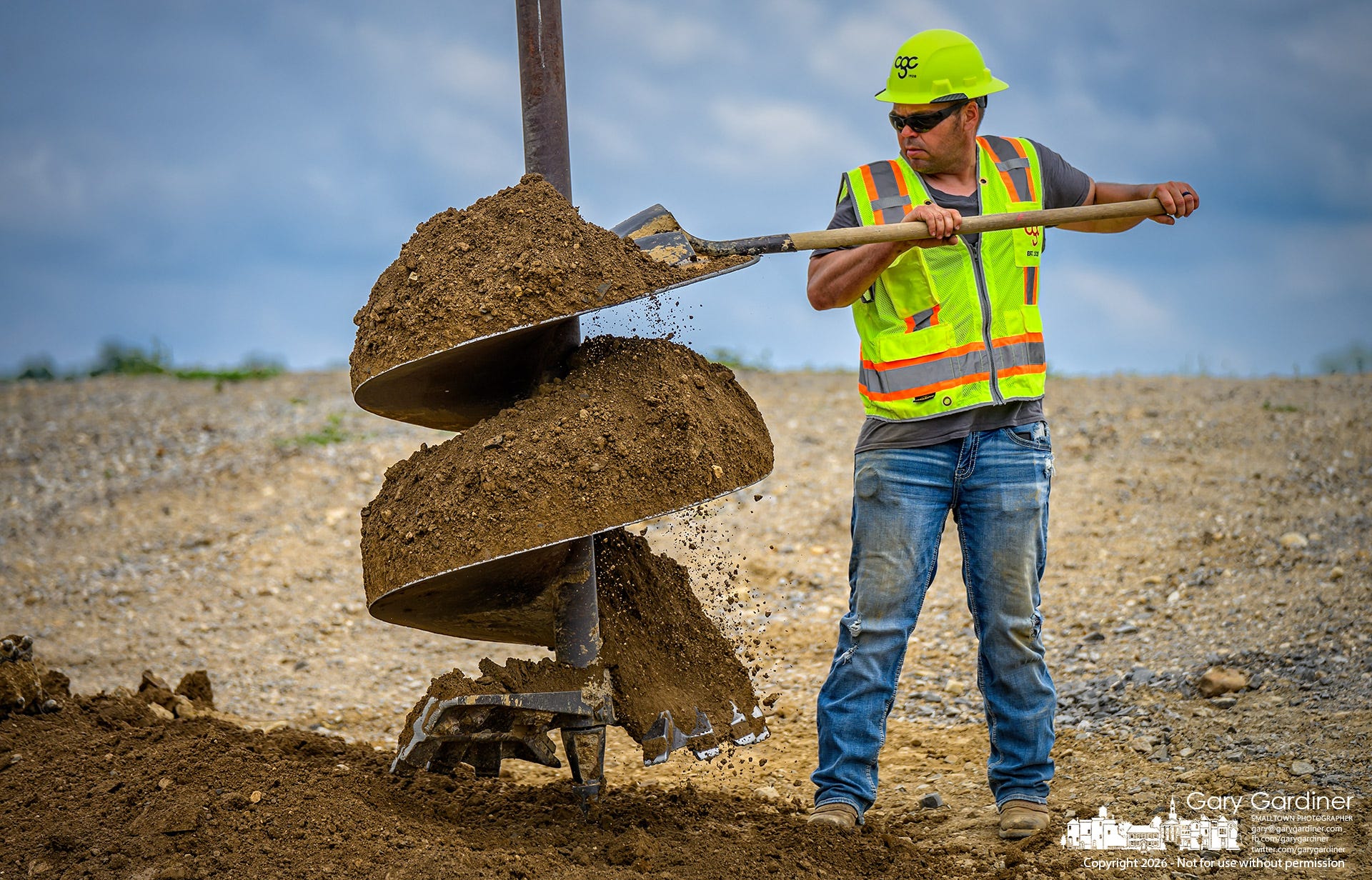
Here, the worker is caught in the middle of a real task, not arranged for the camera. His stance is braced, his hands are spread across the shovel handle, and his attention remains fixed on the auger. That concentration gives the image its credibility and keeps the scene centered on effort. The dirt looks heavy because his body tells us it is.
The composition carries much of the load. The shovel forms a strong horizontal line between the worker and the machinery, linking human action to the machine that drives it. On the left, the auger supplies mass, texture, and mechanical force. On the right, the worker provides color, scale, and purpose.
His neon safety gear immediately separates him from the muted earth and blue-gray sky. The eye finds him first, then follows the shovel toward the auger. That visual path is clean and deliberate, reinforcing the image’s central action even though the scene itself is rough and chaotic.
The flying dirt is essential. Without it, the frame might feel posed or static. Those suspended particles mark the exact instant the shutter was released, giving the photograph a sense of timing. They show not only what the worker is doing, but when the action reaches its most revealing point.
The low horizon also helps. By giving the worker and auger plenty of open sky, the photographer keeps their outlines distinct. The rough ground adds context without crowding the frame. There is plenty happening here, but the picture remains easy to read: worker, shovel, machine, and earth working together.
That simplicity is hard-won. Good action photography depends on more than a fast shutter. It requires patience to wait until posture, motion, and composition come together into a single, readable moment, so the image says one clear thing.
This image succeeds because it makes labor visible. The machine has bulk, the dirt has weight, and the worker gives both a human scale, keeping the photograph anchored in effort.
What photographers can learn
Use action to reveal effort, not merely activity. Let tools create lines through the frame. Place bright colors against quieter surroundings to separate the subject. Keep the background simple when the foreground is already rich with detail. Watch for dust, debris, water, or fabric in motion; small elements often make the moment feel immediate, and the work feel real.
Most of all, photograph concentration. The peak gesture may show what happened, but focus shows what the work demanded, and that is what gives the image its weight.

PhotoCamp Daily isn’t about the technical skills needed to be a good photographer or a photojournalist. There are numerous resources available, including videos, self-help books, training courses, and classes, as well as the power of social media as a learning tool.
PhotoCamp Daily focuses on learning to experience the process of creating good photos, observing subjects, and their connection to storytelling. It’s about learning to express yourself more effectively, shaping a shared understanding of your world, and embracing the new experiences you encounter.
PhotoCamp Daily is always free! But you can pledge support at any time.
