

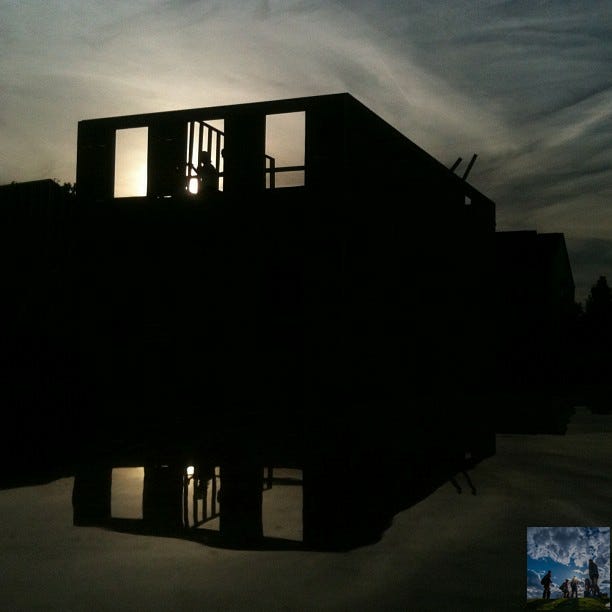
Photographers often talk about capturing detail. Yet, some of the most memorable images are built on withholding it. In this photograph, a house under construction stands almost entirely in silhouette against a bright sky, offering a strong lesson in how mystery can become a compositional tool.
At first glance, the image feels minimal. A dark structure stands silhouetted, while bright sunlight filters through the window openings. Above, a moody sky contrasts with the scene; below, a reflection adds depth. The simplicity gives the image power. By reducing the scene to shape, contrast, and atmosphere, the photographer transforms the unfinished building. No longer a literal document, the building becomes a graphic form, almost a cutout against the sky.
For photographers trying to strengthen their craft, this serves as a useful reminder: exposure is not only technical, but interpretive. In this frame, the photographer chose not to expose for the shadow detail in the building; that decision sacrifices information, yet it gains drama. The house becomes a bold black mass. Suddenly, the sunlit window openings matter much more. Because they break the darkness with intention, the eye is drawn to those rectangles of brightness.
The composition also deserves attention. The building sits heavily in the frame, occupying much of the image. Meanwhile, the sky gives it breathing room. The structure itself is simple and boxy; this simplicity makes the glowing window cutouts stand out even more. Rectangles within rectangles, hard edges clashing with soft clouds, a solid form set against luminous atmosphere—there is a strong geometric quality here. That contrast between rigid construction and fluid sky gives the image tension.
One of the most effective details is the reflection at the bottom of the frame. It is subdued, but it adds balance and extends the mood. Reflections often bring a sense of calm or doubling. Here, it helps turn a straightforward silhouette into something more meditative. The scene feels less like a worksite and more like a visual study in light and form. For photographers, this is a good lesson in using secondary elements well. A puddle, a pane of glass, or a polished surface can quietly elevate an image without demanding attention.
Timing is key: the image depends on the sun’s position. When the light sits behind the structure, the windows turn into portals of brightness, not mere empty openings. If the photographer had arrived at a different time, the effect would have been completely different. Rather than by changing lenses or settings, some photographs are made by waiting for the subject and light to align.
The mood is another strength. Although construction photography is often practical, descriptive, and informative, this image takes a different direction. Quiet and almost cinematic, it presents the unfinished house as symbolic rather than literal. Possibility, transition, or solitude are suggested here. That is a valuable takeaway for photographers in any genre. When photographed with a clear emotional approach, even ordinary subjects can become evocative.
A gentle critique is that the shadows are so deep that some viewers may want a little more separation along the edges of the building. The subject nearly dissolves into the lower darkness, especially at the point where the reflection begins. But that same loss of detail is also part of the photograph’s identity. It commits fully to silhouette, and that commitment gives it coherence.
The lesson for photographers is straightforward. Not every strong image explains itself completely. Sometimes the better choice is to simplify, to let shape replace detail, and to trust contrast and atmosphere to carry the frame. This photograph succeeds because it understands that mood is not an accessory to composition. It is composition.

Today’s coverage leans heavily toward camera gear, lens launches, compact-camera momentum, and photography-adjacent industry developments, with a few notable legal and platform stories that affect how photographers work and share images.
1. Thypoch’s first-ever AF zoom lens is coming – and I used it at The Photography & Video Show
Digital Camera World reports that Thypoch is entering autofocus zooms with a 24–50mm AF lens for Sony E-mount, and the article adds first-hand impressions from The Photography & Video Show. That makes it one of the stronger gear stories of the day, especially for photographers tracking newer lens brands moving upmarket.
2. The beloved retro Olympus PEN isn’t dead! Interview hints that OM System plans to launch a new PEN series
This is one of the day’s more interesting camera-lineup stories. Digital Camera World says an interview suggests OM System plans to revive the PEN series, which matters because the PEN line still has a strong following among photographers who want a small, stylish interchangeable-lens body.
3. TTArtisan Wants You to Pay $400 to Beta Test Its Folding Instant Camera
PetaPixel covers TTArtisan’s debut camera, a retro folding instant model tied to an unusual paid beta program. It stands out because it combines analog-style design, instant photography, and a slightly controversial launch approach, making it one of the more talked-about product stories in the last day.
4. Testing the Very First Four Thirds DSLR 23 Years After it Launched
PetaPixel revisits the Olympus E-1, describing it as the first Four Thirds DSLR and reflecting on how the system fits into digital camera history. It is less breaking news in the conventional sense, but it is a freshly published piece and a strong nostalgia-and-context story for photographers interested in the evolution of digital formats.
5. Photojournalist Sues FAA Over Drone Ban That’s “Impossible to Comply With”
This is one of the most important practical stories for working shooters. PetaPixel reports that a Minnesota photojournalist is challenging a temporary flight restriction that bars drone flights within 3,000 feet of DHS assets, arguing the rule is impossible to comply with in the field.
6. The “best retro compact camera” returns to No.1 in the charts – and Leica celebrates its first best-seller chart success
Digital Camera World says the Fujifilm X100VI has climbed back to the top of the sales rankings, while Leica also makes a notable appearance in the chart. The story adds more evidence that premium compact cameras remain one of the hottest corners of the photography market right now.
7. The highest resolution compact camera yet wins prestigious industry award for “embodying pure photographic pleasure”
This article focuses on the Fujifilm GFX100RF, which Digital Camera World describes as a 102MP medium-format compact that just won an iF Design Award. It is a good example of how high-end compact cameras are now competing on design identity as much as raw imaging specs.
8. These award-winning instant cameras are fun – and from as little as US$117, they make image sharing an experience again
Digital Camera World reports that several Fujifilm Instax cameras have won a major design award. It is a lighter item, but still relevant because it reflects the continued strength of instant photography as both a creative medium and a product category.
9. New Chinese brand Vistilen is planning to release new AF lenses for Canon RF mount
PhotoRumors says a new brand called Vistilen is planning autofocus lenses for Canon RF mount. For Canon shooters, that could be meaningful because third-party RF autofocus lens support has been one of the most closely watched issues in the lens market.
10. Viltrox announced a new retro compact folding Z2 flash for $37 (N/C/S/F)
PhotoRumors reports that Viltrox has introduced a small folding flash compatible with Nikon, Canon, Sony, and Fujifilm cameras. It is a modest accessory story, but it earns a place here because it is fresh, practical, and squarely aimed at photographers who want a compact lighting option.
Taken together, the last 24 hours point to a few clear themes: compact and retro-styled cameras are still driving interest, lens ecosystems remain a major competitive battleground, and legal or policy changes continue to shape how photographers work beyond the camera itself.

PhotoCamp Daily isn’t about the technical skills needed to be a good photographer or a photojournalist. There are numerous resources available, including videos, self-help books, training courses, and classes, as well as the power of social media as a learning tool.
PhotoCamp Daily focuses on learning to experience the process of creating good photos, observing subjects, and their connection to storytelling. It’s about learning to express yourself more effectively, shaping a shared understanding of your world, and embracing the new experiences you encounter.
PhotoCamp Daily is always free! But you can pledge support at any time.