

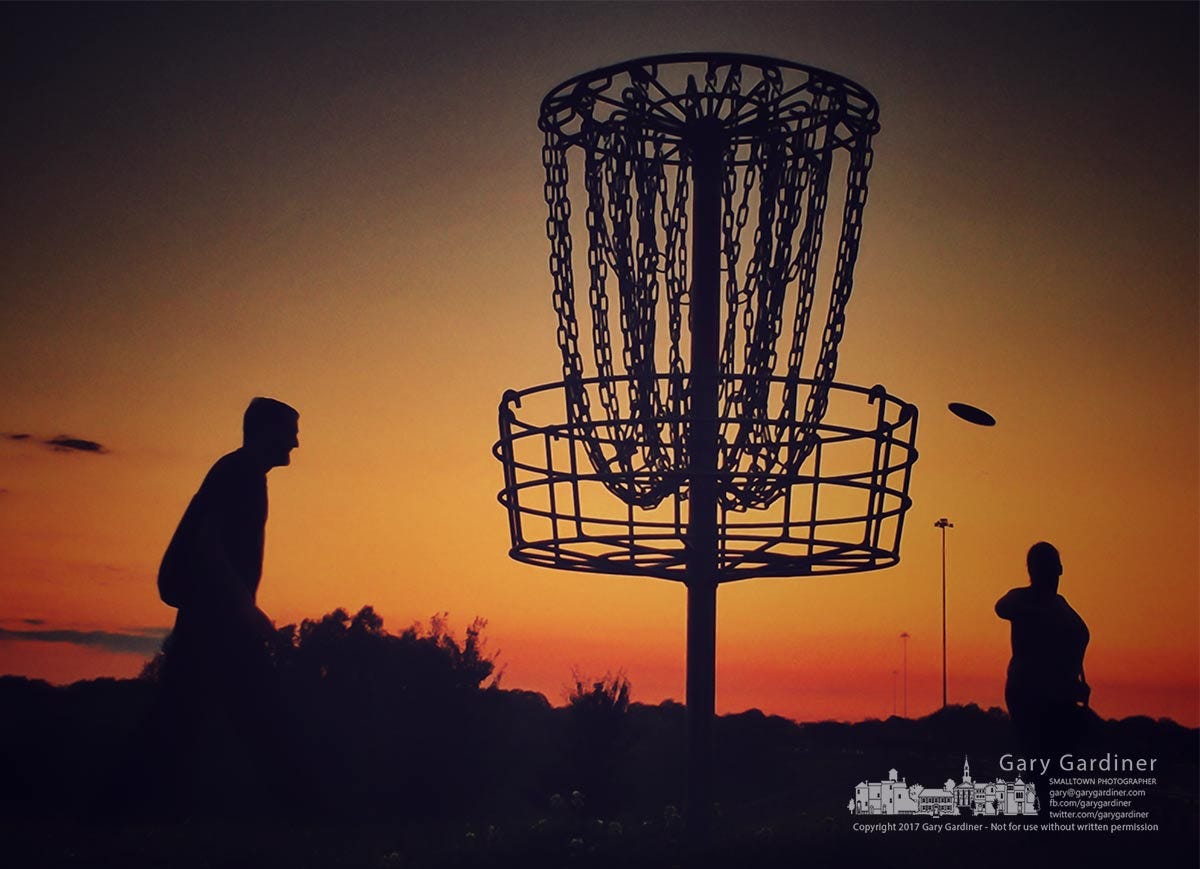
Photos like this show that timing and placement often matter more than the equipment you use. Here, a disc golf basket at sunset, two players in silhouette, and a disc caught in midair turn an ordinary game into a striking study of shape, anticipation, and light.
The first lesson is about timing. The disc is in flight just to the right of the basket, which creates suspense right away. The viewer does not need the whole story to feel the moment. Will it go in or miss? That open question gives the image energy. For photographers looking to improve, this is a helpful idea: action is often most powerful at the moment of uncertainty, not at the start or finish. Henri Cartier-Bresson built his career on this idea, and even though the subject is different, the same approach works. The photo succeeds because it captures the scene at the most visually interesting moment.
Composition is just as important here. The basket stands in the center of the frame, almost like a sculpture. Its chains and round metal shape are detailed enough to draw the eye, while the two people on either side add balance. One stands on the left, watching, and the other is on the right, probably just after throwing the disc. This left-right setup keeps the image lively. The basket is in the middle, but the real focus is the interaction between the thrower, the target, and the disc.
The use of silhouettes gives the photo much of its mood. By setting the exposure for the sky, the photographer lets the people and foreground turn almost black. This removes distractions and turns the subjects into clear shapes. It is a smart move. We do not need to see faces or clothing to understand what is happening. In fact, leaving out those details makes the photo stronger by focusing on gesture and outline. For photographers, this is a good reminder that not every picture needs full detail. Sometimes, shape tells the story best.
Color adds emotion to the photo. The sky moves from warm orange and amber to deep purples and blues, making a rich twilight background. The black silhouettes stand out clearly against these colors. This is a classic photography trick: use simple dark shapes with bright color and let the contrast tell the story. It works here because the sky does more than look nice—it gives the photo clarity, separation, and mood all at once.
There is also a quiet lesson about subject choice. Most people would not think of disc golf as a poetic subject, but this photo shows that almost any activity can be visually interesting if you focus on strong elements. The basket becomes a bold graphic symbol. The disc stands out clearly against the sky. The players look like classic figures, not just individuals. Often, better photos come from seeing the visual possibilities in everyday life instead of waiting for something special.
One small critique is that the basket stands out so much it almost overshadows the people. This might be intentional and fits the graphic style, but a little more space or separation on the right could have made the link between the player and the disc clearer. The watermark in the lower right also catches the eye a bit. Still, neither issue takes away from the photo’s main strength.
The main takeaway for photographers is that strong images come from simplifying a scene to its basics. In this photo, timing, silhouette, and tension turn a simple moment into a powerful composition. By focusing on these basics, any everyday scene can become a photo worth looking at.

PhotoCamp Daily isn’t about the technical skills needed to be a good photographer or a photojournalist. There are numerous resources available, including videos, self-help books, training courses, and classes, as well as the power of social media as a learning tool.
PhotoCamp Daily focuses on learning to experience the process of creating good photos, observing subjects, and their connection to storytelling. It’s about learning to express yourself more effectively, shaping a shared understanding of your world, and embracing the new experiences you encounter.
PhotoCamp Daily is always free! But you can pledge support at any time.