

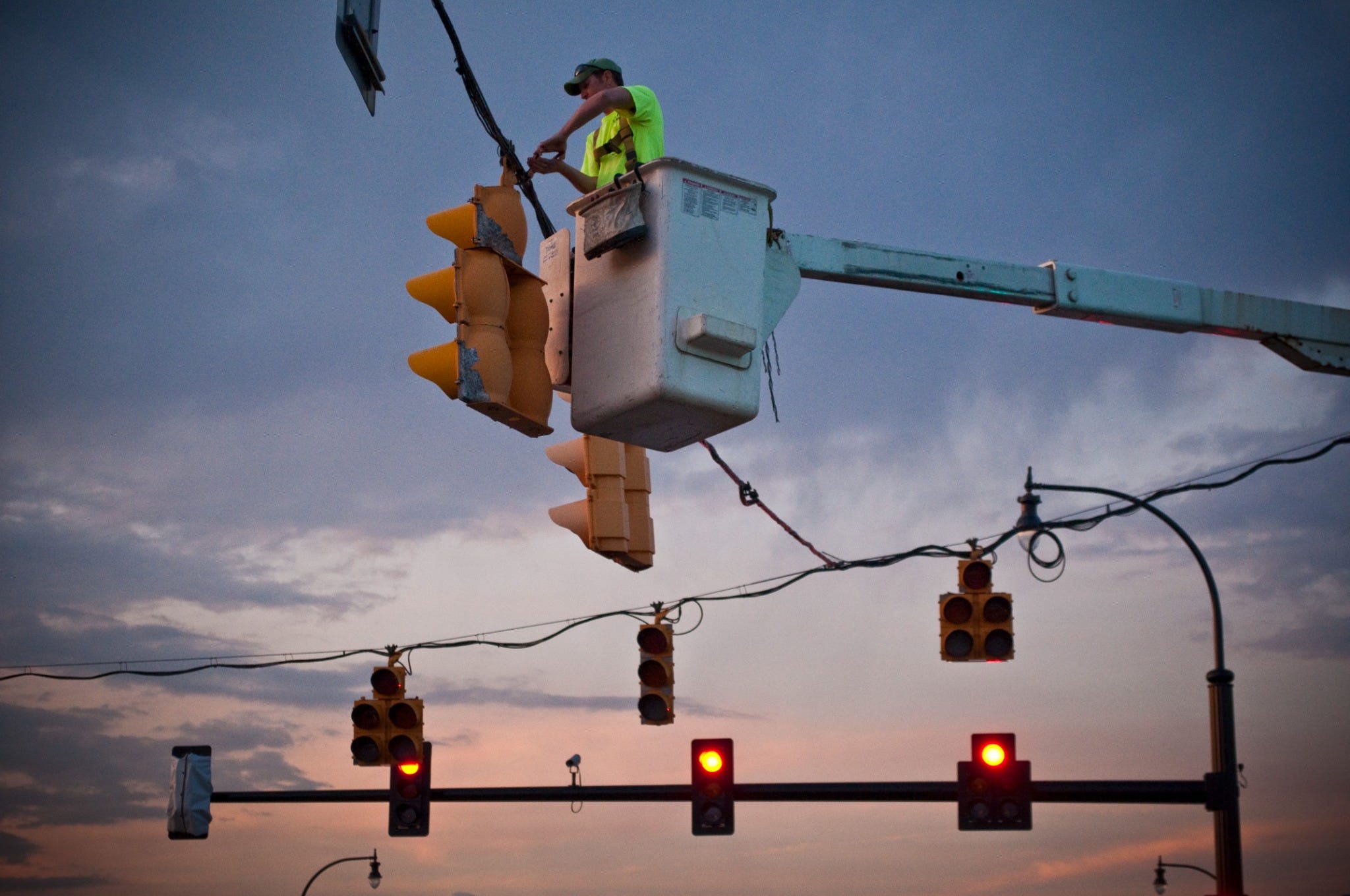
Photographers often overlook work scenes because they seem too ordinary or too functional. But this image of a worker in a bucket truck repairing traffic lights at dusk is a great reminder that strong photographs do not depend on exotic subjects. They depend on seeing tension, scale, and timing in places most people pass without noticing.
What makes this frame work first is perspective. The photographer has chosen a low angle, which immediately gives the scene presence. Instead of looking across at a routine maintenance job, we look up into it. That changes everything. The worker appears elevated and vulnerable, suspended against a wide evening sky, while the bucket arm and hanging signal lights stretch across the frame like lines in a drawing. For photographers trying to improve, this is a useful lesson: sometimes the fastest way to make an everyday subject feel more dramatic is simply to change your vantage point.
There is also a strong lesson here in gesture. The worker is caught mid-task, hands occupied with wiring, body turned slightly inward, fully engaged in the job. That focus gives the image authenticity. It is not just a picture of a person in a bucket truck; it is a picture of concentration. Good documentary-style photography often hinges on that difference. The goal is not merely to show what is there, but to catch the subject doing the thing that reveals the meaning of the scene.
The composition is more layered than it first appears. At the top, the worker and bucket dominate. Across the middle, suspended wires and traffic signals create a horizontal band. Along the bottom, the lit red stoplights repeat in a rhythmic line. Those repetitions help organize the frame. Without them, the scene could feel messy. With them, the image gains structure. This is worth studying as a photographer: repetition can tame complexity. A scene with cables, poles, signals, machinery, and sky can easily turn chaotic, but recurring shapes and colors give the eye a way through.
Color plays an important supporting role. The fluorescent yellow shirt is the visual key. It instantly isolates the worker against the cool blue-gray sky and the pale industrial machinery. Then the red traffic lights below echo that intensity in a different part of the frame. This creates a pleasing color conversation: yellow above, red below, cool dusk tones everywhere else. It is a smart example of how a limited palette can make an image feel intentional even when the scene itself is unscripted.
Timing matters here too. Had this been photographed in flat midday light, it would likely feel far less atmospheric. Dusk gives the image mood. The sky is soft, the lights have started to glow, and the industrial forms stand out more clearly against the background. That balance between ambient light and artificial light is one of photography’s most useful windows. It adds emotion without requiring elaborate technique. Many photographers improve simply by learning to recognize when a scene is visually ordinary at one hour and compelling at another.
There is also an underlying theme of contrast that gives the image life. Human labor is set against infrastructure. The worker is small compared with the equipment and the suspended signals, yet he becomes the emotional center of the frame. The scene combines the mechanical and the human, the static and the active, the quiet sky and the implied noise of an intersection. Strong photographs often thrive on exactly that kind of tension.
A gentle critique is that the frame has a lot of competing lines and objects, especially in the upper area where the boom arm, wires, and signal housing intersect. Some viewers may find that slightly cluttered. A slightly cleaner separation between the worker and the machinery might have made the subject read even faster. But that complexity is also truthful to the subject. Utility work is not visually tidy, and the photograph benefits from preserving some of that real-world density.
The larger lesson for photographers is a valuable one: do not wait for obviously beautiful subjects. Look for scenes where purpose, gesture, and structure come together. A worker fixing traffic lights may not sound poetic, but under the right light and from the right angle, it becomes a study in scale, color, and human effort. That is where better photography often begins—not in finding a better subject, but in seeing more deeply into the subject already in front of you.

Here’s a refreshed photography news digest featuring 10 stories, events, and industry developments published within the last 24 hours. Today’s mix leans broader than pure gear coverage, spanning camera strategy, photo culture, legal fights, historical discoveries, exhibitions, and how photography keeps intersecting with travel, film, and the art market.
1. Panasonic Says a Sports Camera Isn’t the Focus Right Now, But an S1H Successor Is
PetaPixel reports that Panasonic is not currently prioritizing a high-end sports body and instead sees its near-term opportunity in hybrid stills-video cameras, including a successor to the S1H. That makes this one of the clearest same-day strategy stories in the camera industry, because it shows where Lumix thinks it can compete rather than chasing Canon, Nikon, and Sony directly in the sports market.
2. DJI Has Filed a Lawsuit Against Insta360 Over Patent Violations
This is one of the day’s biggest business stories in imaging hardware. PhotoRumors says DJI has filed a patent dispute lawsuit against Insta360 in China, with the case becoming public just as DJI is preparing a push into 360-degree products, making the timing especially notable for photographers and creators who follow the action-cam and immersive-imaging space.
3. How Leica’s New LOBA Women Grant Supports Female Photographers
PetaPixel covers Leica’s new LOBA Women Grant, which will support an unfinished photographic project from proposal through exhibition. Beyond the announcement itself, the story matters because it speaks to a wider photography-world conversation about visibility, funding, and institutional support for women photographers on an international stage.
4. Huge Collection of Vivian Maier Prints Expected to Sell for Up to $1.5 Million
A group of 206 Vivian Maier prints is heading to auction with an estimate of up to $1.5 million, according to PetaPixel. This is more than an art-market curiosity: sales at this scale can influence how an important photographer’s work is valued, collected, and discussed, so it has real significance for photography history as well as the contemporary print market.
5. Never-Before-Seen Photos Show Neil Armstrong After Dangerous Space Flight
PetaPixel reports on newly discovered photographs showing Neil Armstrong after the Gemini 8 mission. It is a strong photography-history item because it combines archival discovery with one of the most recognizable figures in space exploration, and it reminds readers how newly surfaced images can still reshape familiar historical narratives.
6. Backyard Astrophotographer’s Images Play at the End of ‘Project Hail Mary’
This is one of the most uplifting event-style stories in the digest. PetaPixel reports that astrophotographer Rod Prazeres’ deep-space images appear in the end credits of Project Hail Mary, a reminder that independently made photography can break into mainstream cinema in a very visible way.
7. Tourists Must Now Pay $2 to Take Photo of Rome’s Trevi Fountain
PetaPixel says Rome has introduced a small access fee at the Trevi Fountain to control crowds, and the change affects one of the world’s most photographed tourist landmarks. That gives this story unusually broad relevance: it is travel news, public-space policy, and photography culture all at once.
8. This Wristwatch for Photographers Features a Built-In Light Meter
PetaPixel profiles Increment Labs’ LMW-V1, a watch built specifically for photographers with a reflective light meter, golden-hour alarm, and exposure-style readout. It is a niche product story, but a memorable one, because it shows how photography tools are still inspiring entirely new kinds of accessories rather than only incremental camera upgrades.
9. Summit Creative’s New Photo Backpack Can Carry a 1200mm Lens
This gear story is aimed squarely at wildlife and super-telephoto shooters. PetaPixel says Summit Creative’s new Tenzing 70L backpack is designed to carry extremely large lenses, including a Canon 1200mm f/8L, which makes it one of those practical product announcements that will matter a lot to a small but serious slice of photographers.
10. Which Fujifilm Dream Lenses Do Photographers Want the Most?
PetaPixel rounds up the results of Fujifilm’s “Focus on Glass” audience vote, showing which proposed X System lenses photographers found most compelling. While it is not a launch announcement, it is still useful industry intelligence because it reveals what working users and enthusiasts most want from Fujifilm’s future lens roadmap.
Taken together, the last 24 hours point to a few clear themes: photography news is not just about camera launches right now, but also about legal pressure in imaging, stronger support structures for photographers, the continuing cultural power of archives and prints, and the many ways photography keeps spilling into film, travel, and design. (Photo Rumors)
PhotoCamp Daily isn’t about the technical skills needed to be a good photographer or a photojournalist. There are numerous resources available, including videos, self-help books, training courses, and classes, as well as the power of social media as a learning tool.
PhotoCamp Daily focuses on learning to experience the process of creating good photos, observing subjects, and their connection to storytelling. It’s about learning to express yourself more effectively, shaping a shared understanding of your world, and embracing the new experiences you encounter.
PhotoCamp Daily is always free! But you can pledge support at any time.